

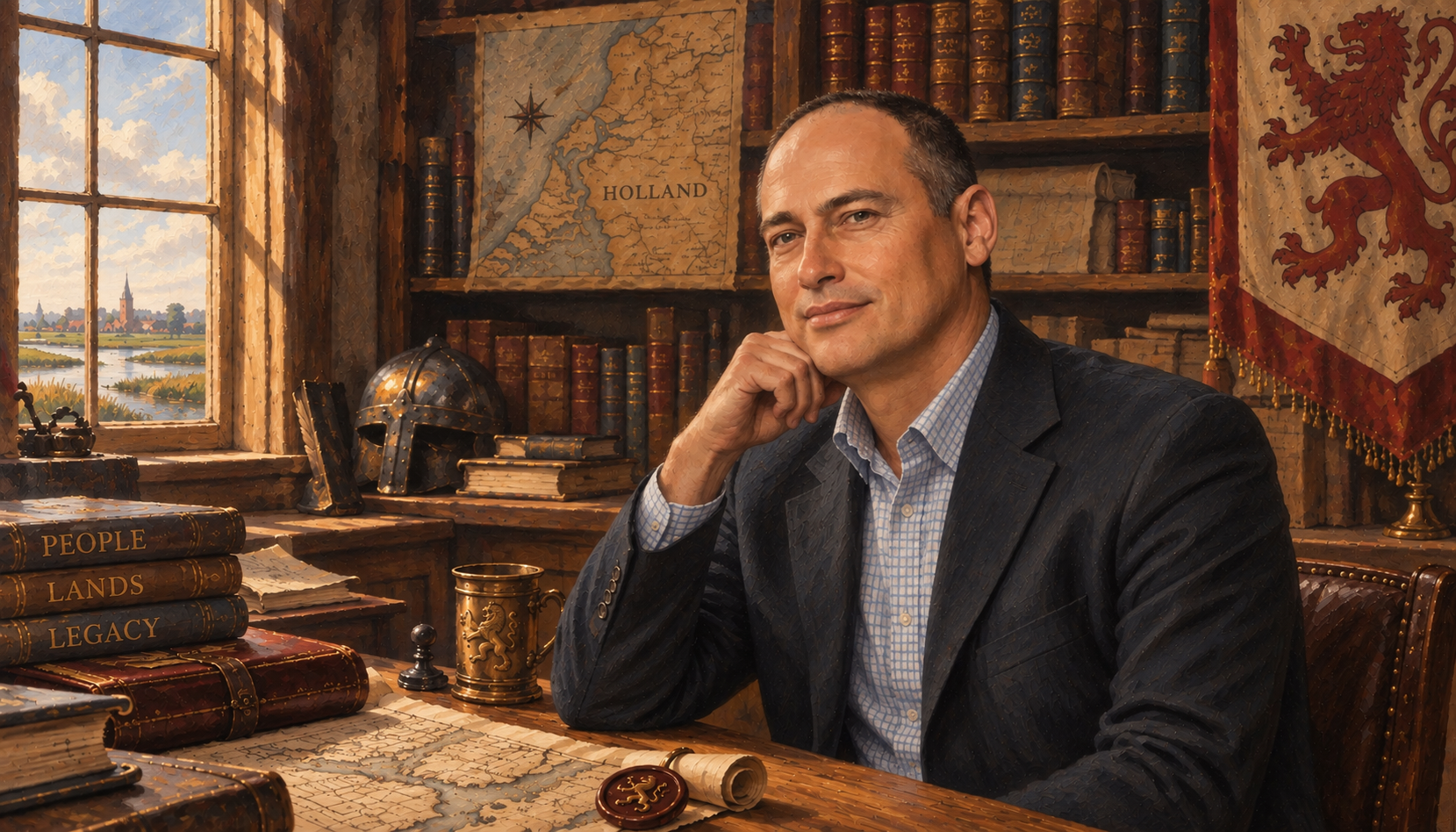
Edward L. Baudoin
Author of the House of Holland series
Edward L. Baudoin is the author of The House of Holland, an epic illustrated historical saga that follows the rise of the family that would become the Counts of Holland.
Born in Leiden and raised in Voorhout, in the shadow of Teylingen Castle, Baudoin grew up in the very landscape his novels describe — the dune country and old estates of South Holland, where the earliest counts held their lands and where the story of Holland began. Genealogical research has traced his own line of descent back to the Gerulfings, the family from which those counts sprang — a lineage he shares, as such research so often reveals, with a great many people whose ancestors came from Holland.
Driven by a lifelong fascination with the Early Middle Ages, Baudoin combines meticulous historical research with compelling storytelling to bring the world of ninth- and tenth-century Northwest Europe vividly to life. His novels weave real historical events together with themes of family, loyalty, ambition, faith, and the difficult choices that shape generations.
Rather than retelling history from the perspective of kings and emperors, Baudoin focuses on the men and women whose courage, sacrifice, and determination laid the foundations of what would eventually become Holland. Every location, event, and character is carefully researched to create an authentic reading experience while remaining an engaging work of historical fiction.
The House of Holland is planned as a multi-volume saga spanning the lives of the early Counts of Holland, allowing readers to follow one family's story across generations as Europe itself is transformed.
When he is not researching medieval chronicles, archaeology, and historical sources, Edward continues expanding the world of The House of Holland, bringing forgotten chapters of European history back to life for modern readers.
How the Research Works
Every volume in the House of Holland series carries a substantial historical appendix — the Historische achtergrond — and the full text of that material is published openly on this site so that any reader can examine it without buying the book first.
The Historische achtergrond is not a vague author's note. It is a systematic account, per volume, of what the documentary and archaeological record actually says, what the author constructed, and where the boundary between the two lies. It operates as a ledger: here is what a chronicle records; here is what a charter confirms; here is what the author invented because the sources are silent. The distinction is stated without hedging on every point.
The principle behind this is candour. Historical fiction earns its credibility not by pretending to be history but by being honest about what it is. When a scene has no documentary basis, the appendix says so. When a character is partly constructed — when no source places a particular figure at a particular event, when a number is a liberty, when a miracle is a thirteenth-century invention rather than a tenth-century fact — the appendix names it. Readers of historical fiction are entitled to know where they stand. The series asks them to trust it, and the way to earn that trust is to show the working.
The primary sources for the series include the major Flemish and Hollandic chronicles, a substantial body of surviving charters from the comital and ecclesiastical archives, the findings of palaeogeographic research in the North Sea delta region, and the work of the Deltares tradition on the physical evolution of the coastal landscape. The geography of the novels — the position of the coastline, the extent of peat cover, the course of the rivers — is grounded in that research rather than in the map as it stands today. The past looked different, and the series is careful to show it that way.
The articles drawn from these appendices are published in the History section of this site. They cover the events, figures, and geography of each volume in detail. They are free to read and carry full citations.
Get in Touch
This address is for press enquiries, translation rights, and reader correspondence. The author reads every message personally and aims to respond within two to three weeks; volume during a publication period may mean a longer wait. For rights enquiries, please include the territory, language, format, and publisher in your first message — it makes the initial exchange more useful for both parties and avoids unnecessary back and forth.
Write to Edward:
Edward is not on social media. Email is the only channel he monitors.