
Four Centuries of the County of Holland — What Is Documented, What Is Legend, and What the Novelist Did with Both
This section is a companion encyclopaedia to the House of Holland novel series, covering the county of Holland from its earliest documented counts (c. 880) to the death of Floris V in 1296. Every article here draws on the same historical research that underlies the novels. It is written for two kinds of reader: the visitor who has just finished a volume and wants to know what was real, and the visitor who arrived from a search engine and has not yet encountered the books at all.
The articles distinguish plainly between what the sources record, what is plausible inference, and what is the novelist's construction. Where a scene has no documentary basis, that is stated. Where a number is a liberty, it is noted. The appendix in each volume already does this; the articles here bring that candour out of the back pages and onto the open web — where it belongs.
Articles are organised three ways: by period (chronological narrative of each era), by theme (questions that cut across multiple reigns), and by person (what the sources actually say about each count, bishop, and supporting figure). Use the indices below, or follow any link from a book page directly to the relevant background.
By Theme — Questions That Cut Across Reigns
Some of the most important historical questions in this series have no neat era boundary. The drainage of the peat began before Gerulf and continued past Floris V. The contest between counts and bishops runs through every volume. The following articles address these cross-cutting themes directly — they are the most re-usable and search-worthy content on this site, and the best entry point for a visitor who has not yet read any of the novels.
How the land was governed
The government of the Carolingian empire looks simple enough at first sight, but it worked in a way we now find hard to imagine, because almost nothing existed of what we take for granted under the word "state": no police, no standing army in most places, no civil service, hardly any written law in the hands of ordinary people. Power was not something impersonal proceeding from an institution. Power was personal, and it rested on loyalty.
The king and the counts
At the summit stood the king, anointed and set in place by God, at least in theory the source of all worldly authority. But the king could not possibly be everywhere at once, and so he ruled through men who represented him. The most important of these was the count (in Latin comes). A count was not a nobleman who owned a territory as a later nobility would own it; he was originally an officer of the king, appointed to dispense justice in a particular district — the county — on the sovereign's behalf, to keep the peace, to lead the men to war and to collect the royal dues.
In return for that service the count enjoyed income and standing, and often received land in fief — a benefice — which he might use for as long as he discharged his office and his loyalty. Here already lay the seed of a tension that would shape the whole Middle Ages: what the king intended as a temporary office and a loan, the counts tended to treat as a hereditary possession. As central authority weakened — and in the ninth century it weakened continually — the counts grew more powerful and more independent, and began to pass their office to their sons as though it were their property. In that development, which unfolded everywhere in the empire, lies the origin of the later territorial princes — and thus of the counts of Holland as well.
The bond of loyalty
What held all this together was the oath. The relationship between king and count, between lord and man, was one of mutual, personal fidelity, solemnly sworn and held to be sacred. The man promised his lord counsel and support, above all in war; the lord promised his man protection and maintenance. To break such an oath was not merely a crime but a mortal sin, an assault on the order God had established. That explains why treachery — the central theme of this novel — was held in this world to be so peculiarly abominable: it injured not only a man, but the very fabric by which society hung together.
At the same time, history shows how frail that fabric was in practice. The annals are full of broken oaths, of counts rising against their king, of allies betraying one another the moment it suited them. The murder of the Viking king Godfrid, of which more later, is a telling example: a man was lured to a meeting under promise of peace and killed there. The oath was sacred, and the oath was constantly violated, and both things were true at once.
Justice and the assembly of the people
Justice was not administered by professional judges but in public assemblies — in our regions called the thing — where the free men of a district gathered under the presidency of the count or his deputy. There disputes were settled, crimes tried and decisions taken. The law applied was not statute issued by the king in the modern sense, but inherited customary law, which the older and more experienced men were expected to know and to remember. The king could send out his envoys, the so-called missi dominici, to oversee matters and set abuses right, but in a remote coastal region such as Frisia such supervision was rare, and in practice the district largely regulated its own affairs.
The particular position of Frisia
Within this whole, Frisia occupied a place of its own. The Frisians were known as a comparatively free people, with strikingly little of the high nobility that dominated the land elsewhere. Many Frisians were free farmers who worked their own ground and acknowledged no one above them save, in the last instance, the king and the count he had appointed. The image of "Frisian freedom" would later, in the High Middle Ages, grow into a cherished myth, and one must be careful not simply to paste that later conception onto the ninth century. But it is true that social relations there were flatter than in the south, that the grip of prince and nobility sat looser, and that a local lord such as Gerulf derived his authority rather from personal ascendancy, ability and the assent of his people than from any inviolable hereditary right.
The revenues of power
How was a kingdom without a system of taxation paid for? Not out of a treasury filled with tax money, as in a modern state, but chiefly out of landholding. The king possessed extensive domains throughout the realm — the so-called crown lands — which supplied him with food, goods and income; on these he and his court lived, and out of these he rewarded his loyal men with grants and fiefs. In addition the sovereign had a right to certain services and levies — tolls on trade, a share in the administration of justice, hospitality and contributions from those beneath him, and above all the duty of military service. Whoever received land in fief did not receive it for nothing: he owed his lord service, in counsel and, above all, in war. The whole edifice rested on this exchange of land for loyalty and service.
The counts become princes
Within this system lay, as has been said, the seed of its own transformation. So long as the king was strong, the count remained his servant. But whenever central authority weakened — through a minor on the throne, a disputed succession, or the endless pressure of the Northmen — the independence of those who exercised power on the spot increased. The count who defended his territory for generations, who left his office to his son, who had his own warriors and strongholds, became in practice less and less an officer and more and more a lord in his own right. At the end of the ninth century, the time of our novel, that development was in full swing. It is precisely in this transition — from royal servant to hereditary prince — that the story of a house such as that of Egmond takes place, and that is why a royal charter carried such weight: it confirmed, in writing and under the seal of the highest power, what a lineage had won for itself with the sword.
Law, honour and the order of society
The society of early medieval Frisia was not a society of equals, but neither was it a rigid order of estates such as later centuries would know. It knew a number of clearly distinguished layers, and it was held together by a network of obligations, honour and — where these fell short — violence.
Free, half-free and unfree
Broadly speaking, three groups were distinguished. At the top stood the nobles or leading men, the families of standing from which the leaders came. Beneath them, and by far the most numerous in Frisia, stood the free: farmers and fishermen who ran their own households, were allowed to bear arms, took part in the thing and conducted their own lawsuits. At the bottom stood the half-free and the unfree or slaves, who possessed no full rights and whose labour belonged to a master. Slavery was an ordinary reality of this world; prisoners of war, the condemned and the descendants of the unfree formed an underclass that is seldom given a voice in the sources, but without whose labour the households of their betters could not have existed.
The Lex Frisionum and the wergild
Frisian law has come down to us in part in the Lex Frisionum, a record of Frisian customary law set down in writing around the year 800, in the time of Charlemagne. It is a curious and illuminating document, for it shows how this society thought about right and wrong. Almost every form of injury and violence was expressed in it as a sum of money: so much for a severed finger, so much for an eye, so much for a killing. That sum was called the wergild — literally the “man-price”, the worth of a human being.
The purpose of this system was not cruelty but the reverse: it was meant to contain the blood feud. For without such a regulated reconciliation, a killing led to vengeance, and vengeance to counter-vengeance, and so to endless feuds between families that could tear whole districts apart. By expressing the damage in money, the law offered a way out: the killer or his family could pay the injured family, and so restore the peace.
A text that never quite became law
The Lex Frisionum is not a code in the modern sense. It appears to be a working draft, most probably assembled by Frankish clerks at one of Charlemagne’s great assemblies at Aachen, and it was never formally promulgated. It survives in a single printed edition of 1557, the manuscript behind it now lost — which is to say that our knowledge of Frisian law rests on a thin thread indeed.
Its unfinished character is precisely what makes it valuable. Where a polished code would have smoothed away the contradictions, the Lex Frisionum leaves them standing. It distinguishes three Frisian districts — the land west of the Vlie, the land between Vlie and Lauwers, and the land east of the Lauwers — and gives different tariffs for each, because custom simply differed from region to region and no one had yet imposed a single rule. Appended to it are the Additiones sapientum, the additions of the wise men Wlemar and Saxmund, who evidently dictated what they knew of the old law from memory.
And in among the Christian provisions sit clauses of startling antiquity. The man who breaks into a temple and carries off the sacred objects is taken to the sea, his ears are split, he is castrated, and he is sacrificed to the gods whose sanctuary he violated. Elsewhere the text permits the exposure of a newborn child, provided it has not yet taken food. These are not the rulings of Charlemagne’s bishops. They are the voice of a heathen world that had not yet finished dying, preserved by accident in a Frankish document — and they are a useful corrective to any picture of the ninth century as tidily Christian.
The tariff of the body
The catalogue of injuries is exhaustive to the point of grim comedy. There is a price for an eye, for an ear, for the nose, for each tooth by position in the jaw. There is a price for each finger, and the thumb is worth more than the little finger. There is a price for a wound that pierces to the bone, and a higher one for a wound that penetrates the body cavity, and a higher one again for a blow that leaves the victim unable to work.
Two principles run beneath the arithmetic, and both are worth grasping, because both are alien to us.
The first is that visibility costs more than damage. A scar on the face was compensated more heavily than a comparable wound hidden beneath clothing, and a blow struck in the presence of witnesses more heavily than the same blow struck in private. What was being priced was not only the flesh but the humiliation — the standing of a man in the eyes of his neighbours. In a society where a man’s worth was what his neighbours believed it to be, a mark on the face was a permanent public statement that he had been bested.
The second is that the tariff attaches to the victim, not to the deed. The same blow, struck by the same hand, cost different sums depending entirely on whom it landed.
The ladder of ranks
Frisian society was ordered in ranks, and the wergild made that order explicit in coin. Between the Vlie and the Lauwers the scale ran roughly as follows: for a nobleman, some eighty solidi; for a freeman, some fifty-three; for a litus, the half-free man bound to another’s land, some twenty-six. The figures vary between the districts, and the manuscript is not always consistent, but the proportions are the point: a nobleman was worth three freemen, and a freeman two half-free men.
Below that line the arithmetic stops altogether. The unfree man had no wergild. His death was not an injury to a family but damage to a possession, and it was settled with his owner as one settles the loss of a horse. That is the hard floor of this world, and no amount of reading about oath-helpers and honour should be allowed to obscure it.
Who paid, and who was paid
Neither the killer nor the victim stood alone. The wergild was owed by the killer’s kindred and owed to the victim’s, and it was divided among the relatives according to fixed shares by degree of kinship — the father and brothers taking most, the cousins and remoter kin their portion. A man’s family were therefore both his insurance and his creditors, and they had a direct and quantifiable interest in his conduct. A violent kinsman was an expensive kinsman.
Nor was payment usually made in coin. Silver was scarce in the ninth century and minted money scarcer still along this coast; the solidus was above all a unit of reckoning. What actually changed hands was cattle, cloth, grain, silver by weight, sometimes land. To assemble a nobleman’s wergild was to strip a farm, and everyone involved knew it.
The count’s share
Over and above what was paid to the injured family there stood the fredus — the peace-money, the fine owed to the public authority for the breach of the peace itself. It commonly amounted to a third, and it went to the count.
This deserves to be stated plainly, because it explains a great deal about how counts behaved. Jurisdiction was not a burden of office; it was an income. The right to hold court, to levy the peace-money, to impose the sixty-solidi ban on anyone who disobeyed a lawful summons, to fine the man who failed to appear for the host — these were among the most reliable revenues a count possessed, and they were fought over accordingly. When a count laboured to extend his jurisdiction over a district, he was not chiefly extending the rule of law. He was extending his rents.
Where judgement was found
The count presided over the court; he did not, however, pronounce the verdict. That distinction mattered, and men noticed when it was violated.
The count summoned the assembly, kept its forms, enforced its findings and collected its fines. But the judgement itself was found by others: by the scabini, the lawmen appointed under Charlemagne to replace the older body of assessors, or — in the Frisian manner — declared by the asega, the law-speaker, whose office was to know the custom and to say what it required. He did not decide the case. He said what the law was, and the assembly recognised it. A count who put words into the asega’s mouth was doing something the whole community could see, and would remember.
How guilt was established
There was no investigation as we would understand it, and no public prosecutor. Without an accuser from the injured family there was no case at all. Where the facts were disputed, the court did not weigh evidence; it turned to proof.
The commonest form was the oath. The accused swore his innocence and brought oath-helpers to swear beside him — not witnesses to the facts, but men of standing prepared to stake their own credit on his word. The graver the charge, the more of them the law required. The point was social rather than evidential: a man who could not find twelve neighbours willing to swear for him had already been judged by his community, and the court merely registered the verdict.
Where oath failed, there was the ordeal — the hand plunged into boiling water to retrieve a stone, the carrying of heated iron, immersion in cold water — and, for freemen, the judicial duel. The trial by cross had been abolished by Louis the Pious in 818. Judgement, in each case, was referred upwards; the court was asking God to answer a question it could not answer itself.
When money was not enough
Not everything could be bought off. Certain offences lay outside the tariff altogether, and for these the penalty fell on the body: treason against one’s lord, the robbing of churches, arson, theft taken in the act or committed by night, desertion from the host. Here the sentence was hanging, or beheading for those of rank, or drowning, or the fire; and short of death there stood mutilation — the hand for theft or perjury, the ear, the brand, and blinding, which in Carolingian practice was the merciful substitute for execution when the condemned man was too well-born to kill.
And here the ranks reappear in their sharpest form. Corporal punishment was, in practice, the penalty of those with nothing to pay with. The freeman was fined; the unfree man was flogged, maimed or hanged, unless his master chose to pay for him, in which case he simply owed his master instead. The same act, two different worlds.
For the great, the repertoire was different again: forfeiture of estates, loss of office, exile, the surrender of hostages, and the tonsure — the enforced entry into a monastery, which ended a man’s line without shedding his blood.
Honour against arithmetic
That this by no means always worked, and that honour often weighed heavier than money, hardly needs saying — the whole heroic literature of the Germanic world is about men who preferred vengeance to payment. The law offered a price; it could not compel a family to accept one. And a man who refused the settlement, or whose kin could not raise it, faced the oldest sentence of all: he was put outside the peace. Outlawed, he could be killed by anyone without compensation, for he no longer had a price.
Which is, in the end, what the whole system was saying. To have a wergild was to be a person. The tariff that reduced a man to a sum of silver was also the thing that made him worth defending.
A note on sources: for Holland specifically in the tenth century the direct evidence is almost non-existent. What is set out above is a reconstruction from the Lex Frisionum, the Carolingian capitularies, and the later Frisian legal texts of the eleventh to thirteenth centuries, which preserve older custom but also project backwards. The proportions are secure; the precise figures should be read as indicative.
Honour and oath
Above money stood honour, and in this culture honour was no incidental thing but the pivot on which everything turned. A man's worth, his place in the community, the trust others extended to him — all of it hung upon his honour, and that honour was continually tested and confirmed. In the absence of written evidence, the law itself rested largely on the oath: an accused man could clear himself by solemnly swearing his innocence together with a number of "oath-helpers" who vouched for his trustworthiness. Where the oath fell short, one could even resort to the ordeal, on the assumption that God would protect the innocent in a trial by hot iron or water. In such a world a man's word, and the trust it deserved, was a matter of life and death — and treachery was the worst crime imaginable.
The blood tie as building block
Anyone who wishes to understand the society of this age must grasp that the most important bond in which a person lived was not the state and not the village, but kinship — the extended family, the kindred. Your kin were your protection and your obligation at once. They stood by you in a lawsuit and swore alongside you in your oath; they took vengeance if you were killed and helped pay if you killed someone; they were the first and often the only ones you could count on in need. A person without kin was a person without a shield, defenceless before the world. This gave the family a weight we can scarcely imagine, and it made a rupture within a family — discord between brothers, treachery among blood relations — something peculiarly unnatural and terrible. A house divided from within lost precisely that which protected a person most in this world.
Marriage and kinship
Marriage in this world was seldom a matter of the heart alone, and among the great almost never. It was a bond between families, an instrument for forging alliances, uniting land and sealing peace. A marriage could end a feud or raise a lineage; it was too important to be left to the feelings of those who married. We see this too in the history that underlies our novel: that the Viking king Godfrid was married to a daughter of the Carolingian house was not love but politics, an attempt to bind a dangerous man to the empire through kinship. That such bonds were broken as often as they were made, and that the blood which sealed them could also be the blood shed over them, is one of the cruel truths of the age.
Daily life
Behind the kings and the wars, ordinary life went on — the life of the great majority who were never named in a chronicle. It is this life that the novel tries to make palpable, and it is here that archaeology has most to tell us.
The house and the yard
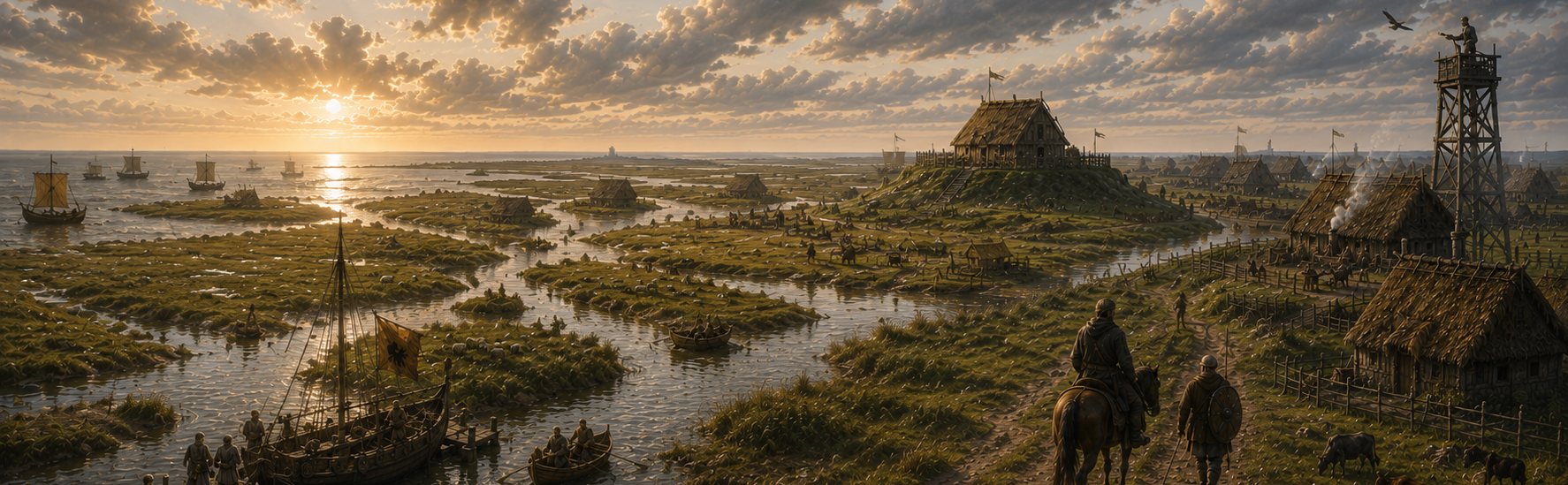
The heart of existence was the farmstead, and its most important building was the longhouse: a long, low structure with walls of timber or wattle and a thatched roof, sheltering man and beast under one covering. At one end lived the household, around an open hearth fire that gave warmth, light and the means of cooking, and that was never allowed to go out entirely; at the other end the cattle were stalled in winter. The warmth of the animals helped to heat the house, and their dung was precious, both for the land and for the raising of the terp. There were no chimneys; the smoke drew out through the roof and hung blue beneath the rafters, so that everything and everyone smelled of woodsmoke — a scent that returns again and again in the novel as the emblem of home and safety.
Farming, cattle and the sea
The Frisian coast dweller lived from a combination of stock-raising, arable farming and fishing, with the emphasis on livestock. The rich salt-marsh soils were pre-eminently suited to keeping cattle and sheep, and so much of the region's prosperity turned on the herd. Sheep supplied not only meat and milk but above all wool, the raw material for the Frisian cloth that was known and sought after far beyond the region. Cattle were wealth on four legs: draught power, milk, meat, leather, and a form of savings that multiplied itself.
There was arable farming too, on the higher grounds — barley, oats, rye, and pulses such as beans — but the wet, salty soil made it an uncertain business. The sea and the creeks supplied what the land lacked: fish, shellfish, seals, and the countless birds of the salt marshes and their eggs. Whoever wished to survive on this coast had to be able to do a little of everything, and above all had to read the water — the tides, the currents, the signs of weather and wind. That knowledge, embodied in the novel by the old fisherman Eilert, was no book learning but an inheritance passed from parent to child, and it could mean the difference between living and drowning.
Food, clothing and health
Daily food was plain and monotonous: bread and porridge of barley or oats, dairy in the form of cheese and butter, dried or salted fish, pulses, and meat on occasion. People drank water, milk and above all beer, which was safer than water from doubtful sources and formed an important source of nourishment. Hunger was never far away; a failed harvest, a cattle plague or a storm tide could bring a district to the brink of starvation.
Clothing was made at home, mainly from wool and linen, woven and sewn by the women of the household — an endless labour that was never finished. People wore what was warm and sturdy, in the natural shades of the wool or dyed with what nature offered in the way of colouring. Of luxury the common man knew nothing; a good cloak, a metal buckle, a knife at the belt were possessions of value.
Health was fragile and life was short. Many children died young; a woman risked her life at every birth; and a wound that festered, a fever, a winter of hunger could fell an adult in the prime of life. Whoever survived childhood and had the good fortune to remain healthy might grow old, but average life expectancy was pressed down heavily by high infant mortality. Death was a familiar member of the household, present everywhere in a way we can scarcely imagine any more — and that constant nearness of death coloured everything, from faith to the manner in which people loved their parents, their children and their comrades.
Women, children and the household
Although it is the men who fight and rule in the sources, a great part of actual existence rested on the shoulders of the women. They managed the household, which was in fact a small enterprise: preparing food, brewing beer, making dairy, spinning and weaving wool and linen, caring for the young stock and the kitchen garden. In a world without shops, virtually everything a family used was made in and around the house. When the man was travelling or away at war, the running of the farmstead fell entirely to the woman. Although the law made her subordinate, a free Frisian woman in practice possessed considerable independence and standing, and the mother who dies early in the novel but lives on in Dirk's memory — a voice in the dark, the smell of wool and woodsmoke — stands for countless women whose names history has not preserved.
The farmer's year
Life was governed by the rhythm of the seasons, a cycle that repeated itself unchangingly and to which everything was attuned. Spring brought the ploughing and sowing, the driving out of the cattle to the green salt marshes, the mending of what winter had broken. Summer was the time of haymaking, indispensable if the cattle were to be brought through the winter, and of the watchful waiting for the harvest. Autumn was the high point and the turning point of the year: the bringing in of the grain, the slaughter of the beasts that could not be fed through, the salting and drying of meat and fish for the lean months. And then winter, the long dark waiting indoors, in which one lived off the stores and prayed that they would reach until the light returned. A setback in this cycle — a wet summer, an early frost, a cattle plague — could mean the difference between a district that survived and a district that starved.
Craft and skill
Although the household was in many respects self-sufficient, this world also knew proficiency and craftsmanship. The most important of all craftsmen was the smith, who worked with iron and fire and whose art — the making of tools and weapons — had something almost magical about it in the eyes of those who did not command it; the smith stood high in esteem, and his workshop was a place of power. Beside him were the woodworkers and shipwrights, indispensable in a world that floated on timber and on boats; the potters; the tanners; and above all the women at the loom, for the making of textiles was an endless, omnipresent labour. Many of these skills were not the business of full-time specialists but of people who practised them alongside their farm work, and the knowledge of them was learned not from books but passed from hand to hand, an inheritance of the body and the eye.
Hospitality, feasting and the spoken word
Against the harshness of existence stood the moments of community, and these were held in high honour. Hospitality was a sacred duty: to refuse a traveller shelter, food and protection counted as a disgrace. The great feasts — at the harvest, at a marriage, on the high days of the church year — were the summits of existence, on which people ate and drank, gave and received, and renewed the bonds of the community. In the lord's hall the beer was poured freely on such occasions, and there too lived the oral culture that in a largely unlettered world carried the memory of a people: the stories, the lines of descent, the songs of heroes and forefathers. What was not written down had to be remembered, and the man or woman who knew the old tales preserved a treasure no less valuable than gold.
Death, present everywhere
Death was, as has been said, a familiar guest, and people dealt with him differently from us. He was not hidden away but surrounded with custom and prayer; the dead were buried in consecrated ground beside the church, in the trust of the resurrection, and care for the souls of the departed — through prayer, through gifts to the Church — was a serious matter that bound the living to the dead. At the same time there lived on beneath the Christian forms an older, heathen sense of the ancestors as a near presence, and of the necessity of honouring them. That a person lived so close to death did not make him unfeeling; it made the bonds between the living, one may suppose, more intimate rather than looser, because everyone knew how frail and how precious they were.
Children and growing up
A child grew up quickly in this world, for childhood as we know it — a long, sheltered time of play and learning — scarcely existed. Whoever survived the first, dangerous years was drawn young into the work of the household: herding cattle, helping in the fields, carrying, fetching, learning by doing. There were no schools for ordinary children; one learned what one needed from parents and elders, with the hands and the eye, and the knowledge of a craft, of the water or of the land was thus passed from generation to generation. By the time a boy was twelve or thirteen — the age of Dirk at the opening of this book — he stood on the threshold of adulthood, old enough to march out, to bear responsibility and, if it came to it, to fight.
That also explains something of the tension that hangs about the young protagonist of the novel. In our eyes a boy of twelve is still a child; in his own he was half a man, waiting impatiently for the moment at which he would count as grown, and pulled back and forth between the protection of childhood and the demands of a world that had little patience with the weak or the wavering. The passage from child to man was no slow, self-evident growth but a border that had to be crossed, often through ordeal and loss — and it is that crossing, with all its pride, fear and ambition, that forms the core of Dirk's story.
War, weapons and the fighting
War in this century was not an exception but a fixed component of life, and for a border region such as Frisia, harried by the Northmen, that was doubly true. Yet the warfare of that time differed utterly from what later centuries understood by it. There were no standing armies, no uniforms, no campaigns lasting months with thousands of trained professional soldiers. War was the business of free men who, when it was needed, laid down their tools, took up their weapons and marched.
The levy: the people in arms
The backbone of the fighting force was the levy, the heerban: the duty of every free man to come out armed when his lord or his community was threatened. It was not an army in our sense but a summoned people, a gathering of farmers, fishermen and craftsmen who fought alongside the few professional warriors — the men of the lord's household — who did devote their lives to the weapon. The quality of such a force depended entirely on the men who led it and on the place and the moment they chose. A summoned levy of farmers was no match for seasoned Northmen in open battle; its strength lay, as the novel repeatedly shows, in knowing its own country, in cunning and ambush, and in the ability of a shrewd commander to force the enemy to fight where and when it suited him.
Weapons and equipment
Armament was simple and reflected the wealth of the bearer. The weapon of the common man was the spear, cheap to make and versatile, and the round wooden shield, often with an iron boss at the centre. Those who could afford it also carried a knife or an axe. The sword was a costly weapon, the work of skilled smiths, and therefore the privilege of the well-to-do; a good sword could be worth a fortune, sometimes received a name of its own, and was handed down as an heirloom from father to son. Protection consisted, for those who could pay for it, of a helmet and a mail coat or a leather war-tunic; most fighters, however, had to make do with no more than their shield and their agility.
Bow and arrow were used, chiefly in hunting but also in war, to strike the enemy at a distance before it came to close quarters. In a world without medicine worth the name, every wound was dangerous; it was not the blow itself but the fever that followed which felled many a warrior days later.
The shield wall
When two forces did meet head on, they generally resorted to the shield wall: a dense rank of men who set their shields against one another so as to form a single unbroken wall, shoulder to shoulder, spears forward. It was not a matter of individual feats of heroism but of cohesion and steadfastness; the rank that stayed a rank longest won. Whoever fell or gave way tore open a gap through which the enemy could penetrate, and once a shield wall broke, an ordered fight turned into a slaughter of fugitives. That is why the hardest virtue of the warrior was not the courage to attack, but the courage to stand — to remain standing in the fear and the noise, shoulder against shoulder, while everything in him screamed to run.
The landscape as a weapon
For a region that was outmatched by the Northmen in manpower and training, the landscape itself was the mightiest ally. The tidal creeks, the mudflats that fell dry and flooded again, the peat that swallowed a careless man, the mist that took away the lines of sight — all of this, in the hands of one who knew it, could be deadlier than any sword. To lure an enemy into the marsh and let the tide do the work, to lay an ambush where the land made flight impossible: that was the warfare in which the Frisians were masters, and by which an outnumbered defender could break a stronger attacker. It is no accident that the decisive battles in this novel are fought not on an open field but at the water's edge; that is how men really fought in these regions.
Strongholds and protection
Besides cunning and landscape, fixed defences were known as well, though in these regions they were simple compared with the stone castles of later centuries. Protection was sought in earthen ramparts, timber palisades and ditches, in fortified halls and in the natural seclusion of the terrain. Some communities threw up ring-shaped enclosures within which man and beast could withdraw in time of danger; a lord strengthened his hall with a fence and a moat. Stone was rare and costly, and castle-building proper would only get under way later, partly as an answer to the very Viking threat this century had so painfully exposed. For the moment one had to make do with timber, earth and water — and with the oldest defence of all: being warned in time. A chain of lookout posts, a beacon lit at the approach of disaster, a rider crossing the district to raise the alarm: such simple means, and the unremitting vigilance they demanded, often meant the difference between a village that brought itself to safety in time and a village overrun in its sleep.
Time, travel and the slow world
To place ourselves in this century, we must also understand something of its tempo. It was a slow world, endlessly slower than ours, in which distance was a serious matter, news moved at the speed of a rider or a ship, and time itself was measured in an altogether different way from the one we are used to.
How time was measured
There were no clocks, no minutes, no hours in our sense. Time was measured by the heavens and by the prayer of the Church: the rising and setting of the sun, the angle of the light, the tides for those who lived on the coast, and — for those who lived near a monastery or church — the fixed hours of prayer by which the clergy divided the day. The year was lived to the rhythm of the seasons and of the church feasts, which marked the agricultural calendar: one reckoned not in dates as we do, but "about Easter", "towards harvest", "after Martinmas". For the farmer the most important calendar work was not that of the numbers but that of nature — when to sow, when to reap, when the cattle must be stalled, when the storms would come.
The years themselves, too, were seldom counted as we count them. Events were dated by the regnal year of a king, or by some memorable occurrence — the year of the great storm tide, the year the Northmen came. An awareness of a continuous, numbered chronology was almost entirely the preserve of the lettered clergy who kept the annals.
Travel and distance
Travel was slow, exhausting and dangerous. Overland one went on foot or on horseback, along roads that were little more than muddy tracks, through woods and marshes where robbers and wild beasts lay in wait and where a traveller was cut off from the outside world. Far quicker and safer was the water: in a land of rivers, creeks and sea coast the boat was the natural means of transport, and the Frisians were pre-eminently a people of the water. But the sea too had its dangers, from storm and fog to the ships of the Northmen.
The consequences of that slowness were profound. A journey we make in an hour cost a day; a trip to the king's court in the south, such as Dirk and Gerulf undertake in the novel, was an enterprise of weeks, a journey into a world that for most coast dwellers was as far off and as unreal as another country. Most people never left the district of their birth; their whole world consisted of the area they could reach on foot and leave again between sunrise and sunset.
How news travelled
In such a world knowledge too moved slowly and unreliably. There was no post, no written news for ordinary people, no way of reporting quickly across a distance. News travelled from mouth to mouth, with merchants, pilgrims, soldiers and messengers, and it changed along the way, as news does. A king could remain for weeks in ignorance of what was happening on his distant frontier; a border count could wait months for an answer from the south. That slowness of communication was no incidental thing but a fundamental feature of power: it forced the king to rule through men on the spot whom he had to trust, and it gave those men — the counts at the edge of the realm — an independence that would in the end break up the empire itself and bring new, local powers to the fore.
The world in the mind
With all this went a wholly different sense of the world from ours. For most people the known earth reached little further than their own district, the neighbouring villages, the market they went to and the places the stories told of.
Beyond that began a twilight zone of hearsay, and beyond that again lay the utterly unknown: distant realms, half-legendary peoples, and finally the edge of the world itself, about the contents of which the learned differed. Maps as we know them did not exist; one oriented oneself not by a picture of the land but by the route, by the succession of landmarks, by the knowledge of someone who had travelled the way before.
For a boy growing up on a terp on the Frisian coast, the king's court in the south was therefore not merely far away in distance but almost far away in reality — a place out of the stories, as unreal as heaven or the land of the heathens, until the moment he should see it with his own eyes. The journey Dirk makes in this novel is thus more than a movement across a map; it is a step out of the enclosed, comprehensible world of his own country into the great, bewildering world of power — a world whose existence he knew of, but whose reality he only learned when it took him in.
Trade, money and the great market of Dorestad
The picture of the early Middle Ages as a time of nothing but poverty and isolation is mistaken. The North Sea was not a barrier but a highway, and along its shores moved a lively trade that made Frisia one of the most prosperous regions of the north.
Dorestad, the window on the world
The shining centre of that trade was Dorestad, lying on the river near present-day Wijk bij Duurstede, at the point where the roads of the interior and of the sea crossed. In the eighth and early ninth centuries it was one of the largest trading places in north-western Europe, a sprawling settlement of timber houses, quays and warehouses, where merchants from the Frankish empire, England, Scandinavia and the Rhineland traded their wares. Here came wine from the south, querns and pottery from the Rhineland, wool and cloth from Frisia, amber and furs from the north, and — a less handsome side of the trade — slaves.
The Frisians were pre-eminently the seafarers and merchants of the north; "Frisian merchant" was almost a set phrase, and Frisian cloth was a byword in far-off regions. Through this trade silver flowed into the region, and the prosperity it produced was part of the reason why the Northmen preyed so eagerly on Frisia.
Coin and exchange
Money existed, but it worked differently from now. In the earliest period small silver coins circulated, called sceattas; later, under the Carolingians, the silver penny (denarius) became the standard. Yet by no means all trade was money trade. Much exchange took place in kind or in silver by weight, and the value of things was often expressed in cattle or in current goods. Coins were also more than a means of payment: the right to strike coin was a sign of power, and whoever put his name on a coin showed that he ruled.
The fall of a trading city
The glory of Dorestad did not last. From the 830s onwards the town was repeatedly plundered by the Northmen, and at the same time natural causes played their part: the course of the river silted up and shifted, so that the harbour lost its function. By the end of the century — the time of our novel — great Dorestad was no more than a shadow of itself, a name recalling a prosperity that had passed. Its decline is the emblem of a whole century: of a flourishing, connected world impoverished and driven in upon itself by violence and disruption.
The Frisian merchant and the wic towns
Dorestad did not stand alone. It formed part of a network of trading places around the North Sea and the Baltic — the so-called wic or emporium towns, such as Quentovic in the north of present-day France, Hamwic near English Southampton, and further off Hedeby and Birka in the Scandinavian north. Along this chain of harbours moved the trade of the north, and the Frisians were its undisputed masters. Their name was so bound up with commerce that in distant parts "Frisian" became almost a synonym for "merchant", and Frisian cloth — the fine woollen stuff of their looms — was worn as far away as the courts of princes well beyond their own coast.
This world of trade linked Frisia to a far larger world than one would expect of a remote coastal region, and it explains an apparent contradiction: that the same district could be at once poor and rich, an outpost at the edge of the inhabited earth and a crossroads of international trade. It was precisely that wealth, and the stream of silver it brought with it, that made Frisia so tempting a prey for the Northmen — and that, once the Viking threat had been mastered, would help lay the foundation of the prosperity on which the later counts of Holland could build their power.
The Northmen in Frisia
No phenomenon marked the ninth century in our regions so deeply as the coming of the Northmen — the Scandinavian seafarers we usually call Vikings. They are the shadow that hangs over the whole story of The House of Holland, and their presence in Frisia was more complex and more prolonged than the simple image of plundering barbarians would suggest.
Who were the Northmen?
The men who harried the coasts of the Frankish empire came out of Scandinavia — from present-day Denmark, Norway and Sweden — a world that had remained outside Christendom and outside the old Roman inheritance. They were not lawless hordes without a society, as the terrified chroniclers liked to portray them, but a people with a highly developed culture of their own: capable farmers, craftsmen and merchants, with a rich narrative tradition, their own law and their own gods. What made them such a scourge was not barbarism but a conjunction of circumstances — population pressure, the hunger for the silver and the wealth of the south, internal struggles for power that drove young men to the sea — and above all their unequalled mastery of the ship.
They were also done an injustice by being seen only as robbers. The same Northmen who plundered also traded, founded settlements, entered the service of princes and, once established, let themselves be baptised and absorbed into the existing world. The Danish leaders who gained authority in Frisia moved on the border between pirate and lord, between heathen and Christian, and their story is one of men who continually changed roles as it suited them. It is precisely that ambiguity — enemy and ally, plunderer and prince — that makes them such disquieting, such human figures, and the novel tries to do them justice by showing them not as monsters but as men.
The wolves of the sea
The Viking raids began towards the end of the eighth century and swelled in the ninth into a true scourge. With their swift, shallow-draught ships the Northmen could strike not only along the coast but also far up the rivers, deep inland, reaching towns and monasteries that had thought themselves safe. They came for plunder: the silver and treasures of the churches, and people whom they could sell as slaves. Their raids were swift, cruel and hard to predict, and it was that unpredictability which made them so feared. The annals of the time are steeped in the fear of them; in many a church, it is said, men prayed for deliverance from the fury of the Northmen.
The ships and the wider world
The strength of the Northmen lay above all in their ships. The Scandinavian shipwrights had developed vessels unequalled in their time: long, slender, light and shallow, as fit for the open sea as for the shallow river, fast under sail and nimble under the oars, and light enough to be dragged overland from one water to another. This gave the Northmen a mobility for which the lumbering, land-bound armies of the Frankish kings had no answer. By the time a sovereign had assembled his levy and put it on the march, the raiders had long since vanished again, laden with booty.
The Northmen in Frisia must moreover be seen as part of a far larger whole. In the same decades great heathen armies were ravaging England, where they overthrew kingdoms; they besieged Paris in 885 and 886; they sailed up the Seine and the Loire and would in the end settle permanently in the territory that was to be called, after them, Normandy — the land of the Northmen. The attacks on the Frisian coast were thus no local phenomenon but one front in a movement that shook all of Western Europe to its foundations. That on this very coast, in these years, Danish power was broken was a small but real turning point in that much larger story.
Rulers instead of raiders
But the Northmen in Frisia were not merely raiders. In the course of the ninth century the Frankish kings repeatedly did something that strikes us as strange: they granted parts of Frisia in fief to Danish leaders, in the hope that these, once lords of the region themselves, would defend it against their own people — making the wolf a shepherd in the hope of quiet. In this way a succession of Danish leaders obtained authority over Frisian territories, among them the well-known Rorik of Dorestad, who exercised a fluctuating power there for decades.
The last of these Danish rulers was Godfrid, called in the sources Godfrid the Dane. A large part of Frisia was entrusted to him by the emperor Charles the Fat, and to seal the bond he married Gisela, a daughter of the Carolingian house. But Godfrid came under suspicion of excessive ambition and of treacherous designs, and his power grew too threatening for the Frankish and Frisian magnates.
Among those suspicions there was, in all probability, a double game which the sources allow us only to surmise. A Danish vassal who had sworn peace could not plunder his own coast without breaking his word in the emperor's sight — but the Northmen seldom operated alone. They formed shifting associations of leaders, captains and loose bands, who worked together and gave one another's ships shelter as it suited them. It is historically quite conceivable that a lord like Godfrid conspired in secret with other Viking leaders: that he let them raid on his coasts and shared in the booty, while keeping up the appearance of loyalty before the court. Whoever carried out the raids then bore no name that could be tied to the vassal, and it was precisely that deniability which made the game so dangerous. In this novel that double game is figured in the nameless ships that harry Egmond's coast: no banner that binds them to Godfrid, only an abandoned raven token betraying his hidden hand.
The murder at Herispich
In the year 885 Godfrid was lured to a meeting under pretext of consultation and, one may assume, under promise of safe conduct, and there killed by a conspiracy of Frankish and Frisian nobles. Among those involved in the deed the sources name, besides a Frankish count and the Saxon count Everhard Saxo of Hamaland — who according to Regino of Prüm struck the first blow — a certain Gerulf: the same Frisian nobleman who four years later was rewarded by King Arnulf and whose descendants would bring forth the counts of Holland. It is this historical event, the violent removal of the last Viking king of Frisia, that forms the core of our novel. The precise course of affairs can no longer be reconstructed from the meagre sources, and much of what the novel tells about it — the conspiracy, the ruse, the treachery surrounding it — is imagination around a historical core: that Godfrid lost his life in 885 through the agency of, among others, Gerulf, and that this meant the end of Danish domination in Frisia.
Two things deserve a note here. The first concerns the occasion. Godfrid's "excessive ambition" had a concrete form: according to the sources he demanded, egged on by his brother-in-law Hugo, not only Frisia but also the rich wine-growing places on the Rhine and Moselle — Koblenz, Andernach and Sinzig — a demand that was read at court as boundless greed and that made the cup run over. (For brevity the novel sums these places up as the "vineyards of the Moselle".) The second concerns a name. Beside Gerulf, a second Frisian lord appears in the tradition around these years, Gardulf — sometimes regarded as his kinsman or ally — one of the Frisian magnates who turned against Danish domination. The novel binds these two data into a single thread by having it be Gerulf and Gardulf who convey Godfrid's demand for the vineyards to the emperor. That is compression; but it stays close to the spirit of the sources, in which both Frisians appear around Godfrid's fall and in which it was precisely that demand for the vineyards which unleashed the quarrel that brought him down.
The turning tide
With the death of Godfrid and, a few years later, the heavy defeat that King Arnulf inflicted on the Northmen at Leuven in 891, the Viking threat in our regions began to wane. It would be generations yet before it had wholly receded, and in other parts of the empire — one thinks of Normandy, where the Northmen settled permanently — history took a different turn. But for the Frisian coast the end of the ninth century ushered in quieter times, in which a local lineage was given room to grow into something lasting.
Faith and Church
The world of the ninth century was religious through and through, in a manner that did not know the modern distinction between "faith" and the rest of life. God, saints and devils were as real as the sea and the weather, and the Church was not only a spiritual but also a political and cultural power of the first order.
The conversion of the Frisians
The Frisians had been brought to Christianity late and with difficulty. Long they had held to their old gods, and conversion went hand in hand with Frankish conquest: the cross followed the sword. The great names of that missionary age are those of Willibrord, the "apostle of the Frisians" who came from England and worked out of Utrecht around the year 700, and of Boniface, who was killed by heathen Frisians near Dokkum in 754 and so became the most famous martyr of these regions. The memory of a heathen past did not lie far behind in the ninth century; the old Frisian king Redbad, who a century earlier had resisted baptism, had become a legendary figure. Beneath the surface of official Christianity, old customs, conceptions and fears undoubtedly lived on for a long time.
The diocese of Utrecht
The ecclesiastical centre of the region was the diocese of Utrecht, founded in the time of Willibrord. The bishop of Utrecht was a man of great authority, not only spiritual but also temporal, for bishops were among the pillars on which the kings rested their government. In the ninth century, however, the Church too suffered heavily under the Northmen; more than once the bishops of Utrecht had to give way before the violence and seek safety elsewhere, with their goods and their relics. In the period in which this novel is set, the episcopal see had for that reason in fact been moved to safer Deventer on the IJssel; only in the course of the tenth century would Utrecht recover its role as seat. The bishop who appears in our novel bears the name Radbod, taken from a real bishop of Utrecht from the beginning of the tenth century who was noted for his learning; the novel places him, for the sake of the story, somewhat earlier than strict history allows.
The monastery and the saints
Beside the dioceses, the monasteries were the other great pillars of the Church, and they were far more than places of prayer. A monastery was a centre of learning, where reading, writing and teaching went on; of agriculture and industry, for the monks owned and worked extensive lands; and of memory, for here were made and kept the books in which the past was recorded. The saints and their relics — the bodily remains or possessions of especially pious dead — stood at the heart of religious experience. It was believed that a saint, though dead, continued powerfully to exist and could protect, heal and assist his own; possession of his relics was therefore a source of standing and protection, and the flight of a bishop with his relics before the Northmen was not merely the rescuing of valuables but the bringing to
safety of a spiritual power.
Beneath the surface of faith
The Christianity of the ordinary Frisian was moreover seldom the pure, learned faith of the theologians. It mingled with older conceptions and practices that did not simply disappear when the cross came. People believed in the efficacy of charms and amulets, in omens and in the power of fate; they feared spirits and evil powers in the dark, in the marsh, at sea. The border between piety and superstition, between prayer and incantation, was fluid, and the Church struggled for centuries, with varying success, against what it regarded as heathen survivals. For the people themselves there was probably no sharp division: God, the saints, the ancestors and the powers of the land were all part of one animate world, in which nothing happened by chance and everything carried meaning.
The rhythm of the church year
The Church gave time itself its shape. The year was no flat succession of days but a recurring cycle of fasts and feasts, of penance and joy, which helped to determine the life of everyone, devout or not. The great high days — Christmas in the heart of the dark winter, Easter with its promise of resurrection when the land grew green again, and the countless saints' days in between — divided the year and gave it its anchor points. People counted on them and lived towards them; they marked not only the faith but also the work on the land, for the church calendar and the agricultural calendar went hand in hand. A date was seldom named by a number and often by a saint.
Thus the Church wove itself into the deepest rhythm of existence, down to the very sense of time. For the lettered monk the year counted according to doctrine; for the farmer on his terp it coincided with the turning of the seasons; and in the practice of daily life the two were inseparable. The bells that in later centuries would strike the hours from the church towers did not yet exist, but even now the Church was, in its own way, the keeper of time — and thereby of the order in which a community experienced its days, its seasons and its life.
The Church as the memory of the world
For the story of The House of Holland one role of the Church is of particular importance: it was virtually the only institution that could read and write. Outside the clergy, literacy was extremely rare; even powerful nobles and kings were often unable, or barely able, to read for themselves. That gave the Church a quiet but enormous power. For whoever writes, preserves; and whoever preserves determines what the future will remember of the past. The charters that fixed rights, the annals that recorded events, the names that were remembered or forgotten — all of this lay in the hands of the men with the goose quill. It is no accident that the rise of the house of Egmond is so closely bound up with a monastery that set down its history, as we shall see in the following chapter.
Writing, charters and the power of parchment
One of the central ideas of this novel is that parchment is in the end mightier than the sword — that a battle lasts a day, but a charter a century. That is no invented wisdom after the fact, but an accurate rendering of how power really worked in this world.
What a charter was
A royal charter was a solemn deed written on parchment by which the sovereign granted or confirmed something: land, rights, privileges, the protection of a monastery, the position of a nobleman. It was drawn up according to fixed, stately formulas in Latin, produced by trained scribes of the royal chancery, and — this was the decisive thing — furnished with the king's seal, an impression in wax that made the deed inviolable. The seal was the king's voice at a distance; it turned ink and parchment into an incontestable right.
Why recognition meant everything
For a local ruler such recognition was of inestimable value. Power that rested on the sword alone was as strong as the last victory and could be disputed at any moment. Power that had been confirmed by the king and set down in writing possessed a legitimacy of an entirely different order: it raised its holder above his rivals, bound him to the highest authority in the realm, and — not unimportantly — could be passed on to his descendants. At the same time it was, as the novel underlines, a two-edged sword: what the king gave, the king could in principle also take away, and whoever owed his position to a charter was thereby also bound to its giver. Recognition was honour and leading-rein in one.
How we know all this
Precisely because charters were so precious, they were carefully preserved, above all by monasteries, which had an interest in being able to prove their property and their rights. Much of what we know about the early counts of Holland we owe to such deeds, preserved or handed down in later copies, and to the annals kept in the abbey of Egmond — the Annales Egmundenses. That the memory of a lineage depended so much on what a monastery recorded and preserved gives the document case entrusted to Dirk in the novel a significance that reaches beyond the story: it stands for the truth that a house lives on for as long as someone knows how to preserve its papers — and with them its history.
Latin and learning
That the Church commanded the written word also meant that it commanded the language of the written word, and that language was Latin. Not the spoken tongue of the people — the Frisians spoke their own Germanic language, and countless vernaculars sounded through the empire — but the Latin of the Roman Church was the language of authority, of the liturgy, of law and of learning. Whoever knew Latin had access to a world that remained closed to the unlettered majority: to Holy Scripture, to the laws and the charters, to the knowledge of antiquity in so far as it had survived the centuries. That knowledge was almost entirely the preserve of the clergy, and within the clergy of a relatively small, trained circle.
The place where the written word was produced was the scriptorium, the writing hall of the monastery, where monks with patient hands copied texts onto parchment — treated animal hide, for paper was not yet known in these regions. It was slow and costly work: a single book could require the hides of a whole herd and months of labour by a practised scribe. Books were therefore rare treasures, carefully guarded and sometimes cased in gold and precious stones. And therefore whoever wrote, and whatever he chose to preserve, largely determined what the future would know of the past. In the silence of the writing halls, far from the battlefields and the burning coasts, another kind of power was exercised, more patient and more durable than that of the sword: the power to determine what would be remembered, and what would be forgotten.
The rise of the house of Holland
Behind the invented boy Dirk and his father Gerulf lies a real history: that of the lineage which was to grow out of this Frisian coastal region into the counts of Holland, one of the mightiest princely houses of the later Low Countries.
Gerulf, the founding father
The historical Gerulf was a Frisian nobleman of the second half of the ninth century who — as the sources record — was involved in the removal of the Viking king Godfrid in 885 and was richly rewarded by the king shortly afterwards. In the year 889 King Arnulf of Carinthia granted him by charter extensive rights and possessions in the Frisian coastal region. This grant counts as a milestone: it marks the moment at which Gerulf's lineage gained a firm footing and stepped out of the nameless throng of local lords into the full light of written history. It is with this historical charter of 889 that Book I ends.
From Gerulf to Dirk
Tradition has the county of Holland begin with a certain Dirk — Dirk I — who is generally regarded as a son or descendant of Gerulf, and to whom in the year 922 the West Frankish king Charles the Simple granted estates around Egmond, among them the little church that was to grow into the famous abbey of Egmond. Whether the boy Dirk of our novel coincides exactly with this Dirk I, and how precisely the family tie between Gerulf and the first counts ran, is a contested matter among historians; the sources are scarce, the names repeat themselves, and much of the earliest pedigree rests on later reconstruction and on the tradition of the monks of Egmond. The novel chooses, within that space of uncertainty, one possible reading and makes a story of it.
A house that would endure for centuries
What is certain is the broad line. Out of this modest beginning — a coastal count on a terp at the edge of the world, rewarded with a charter — there grew in the course of the tenth, eleventh and twelfth centuries a lineage that steadily extended its grip on the Holland coastal region, came to call itself counts of Holland, and finally ranked among the foremost princes of the northern Netherlands. The abbey of Egmond became the spiritual and historical heart of that dynasty: there its dead were buried, there its history was set down, there the memory of the house was preserved. That a world empire such as that of the Carolingians fell apart while out of its forgotten corners new and durable powers arose is one of the great movements of European history — and the house of Egmond is, in miniature, a striking example of it.
A long road to Holland
The road from Gerulf's charter to the mighty county of Holland was long and anything but straight. It cost the lineage generations of patient manoeuvring — of swearing loyalty to one king and then to another as the realms shifted, of marriages, grants and not seldom violence — to grow from a Frisian coastal lordship into a principality that counted. The counts extended their territory step by step, along the coast and inland across the peat, and bound the fragmented powers of the region to themselves. Only in the course of the eleventh and twelfth centuries would the name "Holland" — probably derived from a word for "wood-land" or for boggy, hollow land — displace the old name Frisia for this region, and would the lineage rightly begin to call itself counts of Holland.
In that long process the abbey of Egmond played a role that can hardly be overestimated. Founded on ground that belonged to the oldest possessions of the house, it became the spiritual heart of the dynasty: the place where its counts were buried, where prayers were said for their souls, and — of the greatest importance to the historian — where its past was set down in writing. The monks of Egmond kept the annals to which we owe much of our knowledge of the early counts, and they shaped, consciously or unconsciously, the image their descendants formed of themselves and of their forefathers. Lineage and monastery were thus inseparably bound: the one supplied the power and the protection, the other the memory and the legitimation. That a house lives on for as long as someone preserves its history — the thought woven in this novel around the document case — became reality on a grand scale in the alliance between Egmond and its counts.
The contested pedigree
Anyone who delves into the oldest history of the house of Holland enters a minefield of scholarly quarrels. The sources are scarce and sometimes contradictory; names repeat themselves from generation to generation, so that one Gerulf is hard to distinguish from another and one Dirk from another; and much that is handed down as established fact turns out on closer inspection to rest on later reconstruction, on the tradition of the monastery of Egmond, or on the lineage's own need to make its descent appear as distinguished as possible. Whether the Gerulf of 885 and 889 was really the father of the Dirk who received the Egmond estates in 922; how exactly the generations followed one another; whether the line ran unbroken or had here and there to be patched — about all this historians have argued and are arguing still.
For the novelist that uncertainty is no obstacle but a sanctuary. Where the scholars cautiously enter their reservations and place their question marks, the story may choose. It takes the most appealing of the possible readings — that the boy Dirk, son of Gerulf, grows up to be the founding father of a great lineage — and makes of it a truth that holds within the novel, without claiming that it is the truth of history. Let the reader who afterwards opens the reference works be warned, then, and invited: he will discover that much of what has here been told with the certainty of a story is in reality surrounded by the honest doubt of those who take the past seriously — and that it is precisely that doubt which is one of the most fascinating things about this half-forgotten century.
By Period — The History as It Unfolded
Chronological narratives of each era, for the reader who wants to understand the setting before or after reading a volume.
Dirk I · c. 880–923
Dirk II · c. 940–988
Arnulf · 977–993
Dirk III and beyond · 993–
1. A world of which we know little for certain
The ninth century is for us a half-darkness. There are no diaries, no letters from ordinary people, no portraits. What we know we owe to three kinds of source, and each of them has its own limitation. The chronicles and annals, kept in monasteries, record kings and battles and are silent about the rest; they were moreover written by clerics, with a cleric's eye. The charters — the deeds by which rulers granted or confirmed land and rights — are of inestimable value because they name names, places and dates, but they tell us only about possession. And archaeology, the silent testimony of the ground, shows us how people lived, ate and worked, but never names a name.
Out of these three arises a sketch, not a painting. For large parts of the story — how people thought, what they feared, what was actually said — all the sources are silent at once. It is precisely there that the novel speaks: not to contradict the facts, but to do what no source can, namely to let a vanished world breathe again.
2. The disintegrating empire and the road to Arnulf
In the year 800 Charlemagne had been crowned emperor in Rome and had united the West under one crown. What he had forged together with iron and will did not hold after him. His heirs divided the empire, divided it again, and fought one another more fiercely than they fought any outsider. Frisia lay in the vulnerable border country where the realms touched and authority was thinnest.
The second half of the century was for the Carolingian house a time of decline: rulers who died young, without a legitimate heir, or without the strength to rule. Emperor Charles the Fat, who in 885 briefly held almost the whole empire in his hands, proved the weakest of them all; in 887 he was deposed in favour of his nephew Arnulf of Carinthia, an illegitimate scion who took his power instead of inheriting it. It is this Arnulf who in this novel seals the charter for Gerulf: a hard and calculating man, who understood that a king rewards not out of gratitude but out of calculation.
One should form no picture of that kingship on the model of later monarchs on a throne in a capital. The Carolingian king travelled ceaselessly, ate his way through his own lands and governed by being present. Where he was not, whoever was present ruled — and on the Frisian coast that had for generations been no one from the south.
3. Frisia: water, mound and coast
The Frisia of the ninth century was not the Friesland of today. The name covered a far longer coastal strip, reaching roughly from present-day Flanders to beyond the Weser: a world of salt marshes, mudflats, creeks, peat bogs and dunes, where the distinction between land and water was fluid and shifted twice a day. There were no dykes as we know them. People lived on mounds — hills raised by hand out of clay, dung and sods, heightened over generations — which stood out like islands above the water when the storm tide swallowed the land.
The part of Frisia in which this novel is set, the coastal strip of the later Holland around Egmond in the old region of Kennemerland, was an outer corner: thinly populated, poor in grain, rich in fish, salt and cattle. And yet it was precisely that position that was of strategic importance, for a reason that recurs throughout the book. Here lay the river mouths by which the Northmen could sail into the heart of the empire, and no king had ever been strong enough to close that door.
The sea that made the land fertile with its silt could swallow it in a single night. That made the people sober, tough and mistrustful of prosperity, and it impressed on them a truth that sounds through this novel again and again: that nothing man possesses endures, and that survival is not a matter of strength but of knowing the land better than those who wish to fight it.
4. The Northmen and the Danish fief
The Scandinavian seafarers we call Vikings were no lawless hordes without a society, as the terrified chroniclers liked to portray them. They were a people with their own law, their own gods and a highly developed craftsmanship, and what made them such a scourge was not barbarity but their unequalled mastery of the ship: long, slender and shallow, as suited to the open sea as to the creek, and light enough to be dragged overland from one water to another. By the time a Frankish ruler had his levy on its feet, they had long since gone.
The Northmen in Frisia, however, were not merely robbers. In the course of the ninth century the Frankish kings repeatedly did something that strikes us as strange: they granted parts of Frisia in fief to Danish leaders, in the hope that these, once lords of the region themselves, would defend it against their own people — making the wolf a shepherd in the hope of quiet. So in succession various Danish leaders received authority over Frisian territories, among them the well-known Rorik of Dorestad, who exercised a fluctuating power there for decades.
The last of these Danish rulers was Godfrid, called in the sources Godfrid the Dane. A large part of Frisia was entrusted to him by Emperor Charles the Fat, and to seal the bond he married Gisela, a scion of the Carolingian house. But Godfrid came under suspicion of excessive ambition and of treacherous designs, and his power grew too threatening for the Frankish and Frisian magnates.
Among those suspicions was, in all probability, a double game that the sources allow us only to guess at. A Danish liege lord who had sworn peace could not plunder his own coast without breaking his word in the emperor's sight — but the Northmen seldom operated alone. They formed shifting associations of leaders, captains and loose bands, who cooperated and gave each other's ships shelter as it suited them. It is historically quite conceivable that a lord like Godfrid conspired secretly with other Viking leaders: that he let them raid his coasts and shared in the plunder, while maintaining before the court the appearance of loyalty. Whoever carried out the raids then bore no name that could be tied to the liege lord, and it was precisely that deniability that made the game so dangerous. In this novel that double game is figured in the nameless ships that harry Egmond's coast: no flag to bind them to Godfrid, only an abandoned raven token that betrays his hidden hand.
5. The killing at Herispich, 885
In the year 885 Godfrid was lured to a meeting under the pretext of negotiation and, as we may assume, under promise of safe conduct, and there killed by a conspiracy of Frankish and Frisian nobles. Among those involved in the deed the sources name, besides a Frankish count and the Saxon count Everhard Saxo of Hamaland, who according to Regino of Prüm struck the first blow, a certain Gerulf as well — the same Frisian nobleman who four years later was rewarded by King Arnulf and whose descendants would produce the counts of Holland. It is this historical event, the violent removal of the last Viking king of Frisia, that forms the core of our novel. The precise course of events can no longer be reconstructed from the meagre sources, and much of what the novel tells about it — the conspiracy, the stratagem, the treason surrounding it — is imagination around a historical core: that Godfrid lost his life in 885 through the agency of, among others, Gerulf, and that this meant the end of Danish domination in Frisia.
Two things deserve a note here. The first concerns the occasion. Godfrid's “excessive ambition” had a concrete form: according to the sources he demanded, egged on by his brother-in-law Hugh, in addition to Frisia the rich wine towns on the Rhine and the Moselle — Koblenz, Andernach and Sinzig — a demand that was read at court as boundless greed and that made the cup run over. (For brevity the novel sums these places up as the “vineyards of the Moselle”.) The second concerns a name. Alongside Gerulf, a second Frisian lord appears in the tradition surrounding these years, Gardulf — sometimes regarded as his kinsman or ally — one of the Frisian magnates who turned against Danish domination. The novel binds these two data into a single thread by making it Gerulf and
Gardulf who convey Godfrid's demand for the vineyards to the emperor. That is invention; but it stays close to the spirit of the sources, in which both Frisians appear around Godfrid's fall and in which it was precisely that demand for the vineyards that set off the quarrel that brought him down.
With the death of Godfrid and, some years later, the heavy defeat King Arnulf inflicted on the Northmen at Leuven in 891, the Viking threat in our regions began to wane. It would be generations before it had entirely receded, and in other parts of the empire — one thinks of Normandy, where the Northmen settled permanently — history took a different turn. But for the Frisian coast the end of the ninth century ushered in quieter times, in which a local line was given room to grow into something lasting.
6. Gerulf, the charter of 889, and the house that followed
The historical Gerulf was a Frisian nobleman of the second half of the ninth century, who according to the sources was involved in the removal of Godfrid in 885 and shortly afterwards was richly rewarded by the king. In the year 889 Arnulf of Carinthia granted him, by charter, extensive rights and possessions in the Frisian coastal region. That grant counts as a milestone: it marks the moment at which Gerulf's line gained a firm footing and stepped out of the nameless crowd of local lords into the full light of written history. It is with this charter that Book I ends.
The tradition has the county of Holland beginning with a certain Dirk — called Dirk I — who is generally regarded as a son or descendant of Gerulf, and to whom in the year 922 the West Frankish king Charles the Simple granted properties around Egmond, including the little church that would grow into the famous abbey of Egmond. Whether the boy Dirk of our novel coincides exactly with this Dirk I, and how precisely the family bond between Gerulf and the first counts ran, is a disputed matter among historians; the sources are scarce, the names repeat themselves, and much of the earliest genealogy rests on later reconstruction and on the tradition of the Egmond monks. The novel chooses, within that space of uncertainty, one possible reading and makes a story of it.
What is certain is the broad line. Out of this unremarkable beginning — a coastal count on a mound at the edge of the world, rewarded with a piece of parchment — there grew in the course of the tenth, eleventh and twelfth centuries a line that steadily extended its grip on the coastal region, came to call itself counts of Holland and eventually ranked among the foremost princes of the northern Netherlands. The abbey of Egmond became the spiritual and historical heart of that dynasty: there its dead were buried, and there its history was set down. Line and monastery were inseparably bound — the one supplied the power, the other the memory.
Anyone who goes into the earliest history of that house, meanwhile, enters a minefield of scholarly dispute. The sources are scarce and sometimes contradictory; names repeat themselves from generation to generation, so that one Gerulf is hard to distinguish from another; and much of what is handed down as established rests on later reconstruction or on the tradition of the monastery itself. For the novelist that uncertainty is no obstacle but a sanctuary: where the scholars enter their reservations, the story may choose — without claiming that its choice is the truth of history.
7. History and imagination: a note of account
A historical novel always moves along the border of two worlds: that of what really happened, and that of what might have happened. It seems fitting at the close of this background to indicate where in The House of Holland history ends and imagination begins.
What rests on history
The larger framework is historical. The disintegration of the Carolingian empire, the Viking threat, the Danish domination of parts of Frisia, the killing of King Godfrid in 885 with the cooperation of a certain Gerulf, Gerulf's reward and the royal charter of 889, King Arnulf of Carinthia and his calculating policy, the bishopric of Utrecht, the world of mounds, tides, trade and wergild — all of this is founded on recorded history, so far as that can be known from the scarce sources.
What has sprung from imagination
The people themselves, as they live and breathe here, are largely imagined. Of the historical Gerulf we know virtually nothing personal; his character, his cunning, his way of thinking are the novel's. His sons Dirk and Waldger, their brotherly relationship and the rift that grows between them, the mother Hilde, the friend Erenbald, the old warrior Aelbert, the fisherman Eilert — they are creatures of the story, however much they are intended as truthful representatives of their time. The Viking Hrolf Blackcloak, the conspiracy with its passwords and betrayal, the “hidden testimony” that runs like an invisible thread through the story — this is the stuff of the novel, woven around the historical core.
With the chronology, too, and with a few figures, liberties have been taken where the story called for them. Thus the bishop Radbod has been brought on stage somewhat earlier than strict history allows, and events that stretched over years have sometimes been drawn closer together than they actually occurred. Such interventions are the unavoidable right of the novelist, who is writing not a textbook but a story, and who fills in the silences of history not in order to falsify it, but in order to make it felt.
Filling in the silences
For that is in the end what a historical novel does, and what it can do where historiography must be silent. The sources tell us that Godfrid was killed in 885 and that Gerulf was involved; they do not tell us how it felt to live through that summer, what a twelve-year-old boy saw and feared, how a Frisian hall smelled and how it sounded when the tide turned. There the imagination begins, and there it may begin — not against history, but in its service, to let a world that really existed breathe again for those who read of it more than eleven centuries later.
One such silence is the precise seat of Godfrid's power. The sources do not name it; this novel places it at Tiel, and that is not arbitrary. When the great Dorestad sank away, its role as a toll and trading place on the river passed to Tiel, which flourished in the tenth century — so that the registers, the toll and the memory of a fief most naturally belong there. And Tiel lies in Teisterbant, and there lies the finest echo of all: it was Gerulf's own son Waldger who became count in Teisterbant and who in 898 killed Everhard Saxo — the same man who had struck Godfrid the first blow at Herispich. So when in this novel the young Waldger takes and holds the stronghold at Tiel, he is, without knowing it, anticipating his own history.
A second liberty concerns the secret compact Gerulf makes in this novel with the bishop of Utrecht: that the bishop receives the district of Nifterlake — the land along the Vecht, with Muiden and its tolls — as the price of the imperial connivance at the coup. This is invention. Nifterlake really was the early medieval district around Utrecht and along the Vecht, and the bishop of Utrecht really would acquire temporal power over it — but only in 953, when Emperor Otto I granted the district, with Muiden and the toll rights, to the church of Utrecht. That is nearly seventy years after the events of this book. The novel brings that grant forward and turns it into a piece of political horse-trading, because it wishes to show the quiet, paper side of power alongside the loud, steel side.
The irony reaches further. It was not the bishop but Gerulf's own son Waldger who was count in Nifterlake in the early tenth century — alongside Teisterbant, Lek and IJssel and Opgooi. Historically, then, the Vecht country remained precisely in the family; more than that, in the power vacuum of the Viking age the Hollanders took a great deal of episcopal land in the Vecht country, not the other way round, and out of that grew a centuries-long struggle between the county of Holland and the See of Utrecht over that inhospitable peat. The compact in this novel reverses that real direction. But it does touch a genuine fault line — and readers who wish to may take the secret pact between coastal lord and bishop as the imagined germ of a quarrel that would mark the map of the Low Countries for centuries to come.
A third liberty, finally, concerns the numbers. The sources for this period and region almost never give figures, and where they do, they are to be read with great caution. What we do know is that the armies of the early Middle Ages were small by our standards: not tens of thousands, but a few hundred to at most a few thousand — and that a regional Danish force holding a coastal region such as Frisia in check must be thought of in hundreds rather than thousands. This novel makes a working hypothesis of that: that in Godfrid's day some four hundred Danish warriors commanded this coast, and that this number crumbled away in the years after his death — some fallen at Herispich and at the stronghold, some returned over the sea to Denmark, some hunted down in the years that followed — until at Raven Creek a last hundred remained, facing a roughly equal Frisian force. Those figures are nowhere recorded; they have been chosen to give the events a recognisable, human scale, and as an order of magnitude they fit what we may assume about the warfare of that century. It should be borne in mind that the small number did not make the stakes any smaller: in a world of mounds and hamlets, a force of a few hundred could decide the fate of a whole region.
A closing word
Anyone who after reading this novel wishes to know more about the real history will find that its very core — the earliest counts, the circumstances of Godfrid's killing, the descent of the House of Holland — belongs among the most discussed and least certain subjects in the history of the Netherlands. That is no shortcoming but an invitation. It is precisely in this half-dark age of transition, where the sources whisper instead of speaking, that history and imagination need each other most. Historiography preserves the scarce facts we have; the novel tries to give back the world in which those facts lived. Both, so the author hopes, serve in the end the same purpose: to bring a vanished century, and the people who inhabited it, back to life for the length of a story.
Dirk II and the politics of the Ottonian empire
The county in the context of the Saxon emperors
The bishopric of Utrecht and the first land disputes
How ecclesiastical and comital power first collided
940–988: consolidation on a shrinking coast
The physical and political geography
Arnulf, count of Holland: the man and the sources
What documentation actually survives
The Italian campaign of 982: Crotone and its aftermath
The historical battle, and what is known of Arnulf's role
977–993: a county in tension
The disputed territory, the bishop's ambitions, the count's position
Dirk III and the toll wars: Vlaardingen 1018
The battle that defined the county's independence
993–1039: the county comes into its own
The period when Holland begins to look like a coherent political unit
Planned: later periods through Floris V (– 1296)
Articles forthcoming as the series progresses
The People — Who's Who, 880–1296
Four centuries and a family that reused four given names. The who's-who exists because by Book VIII it becomes indispensable, and because it is genuinely useful now. Each entry states what the sources record, what is legend, and which volumes the figure appears in.
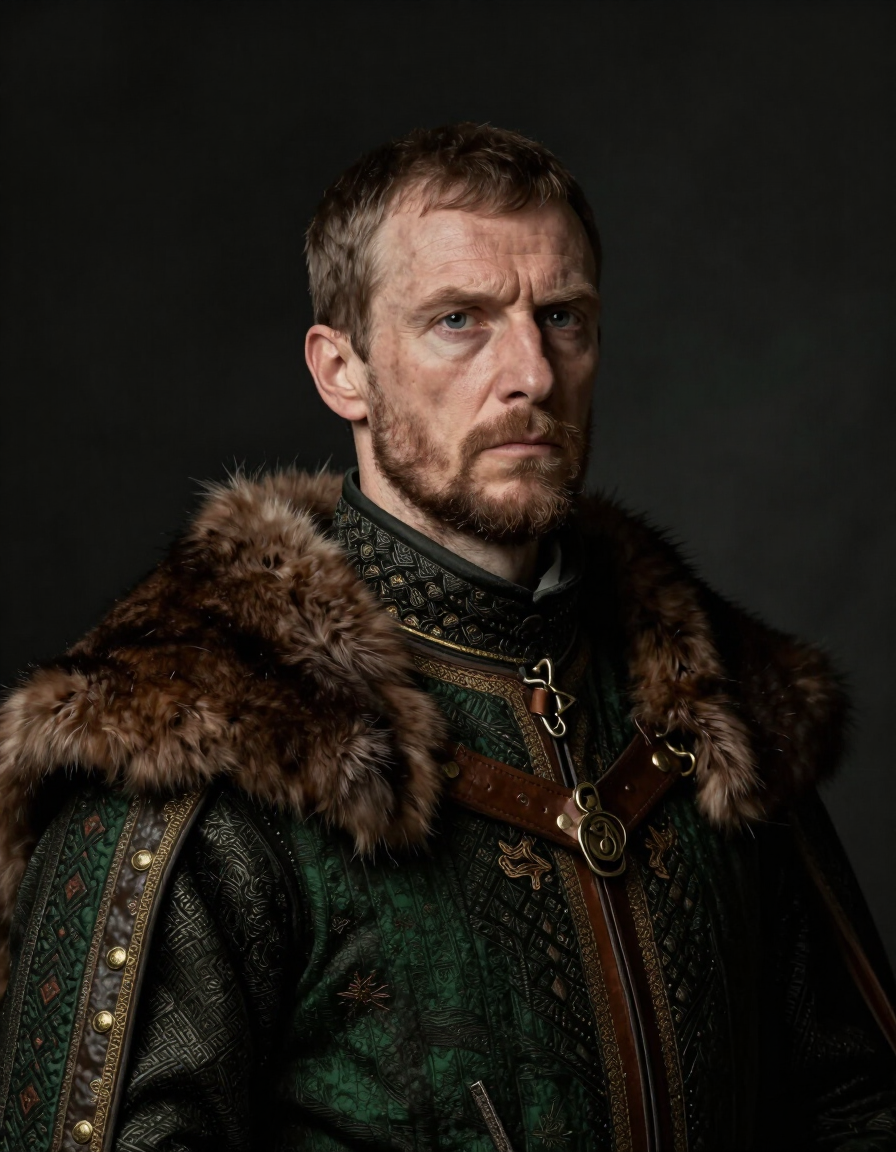
Dirk I
c. 880 – c. 928
The first documented count of Holland; his grant from the Carolingian king is the founding moment of the family's claim to the delta.
Appears in: Books I–III
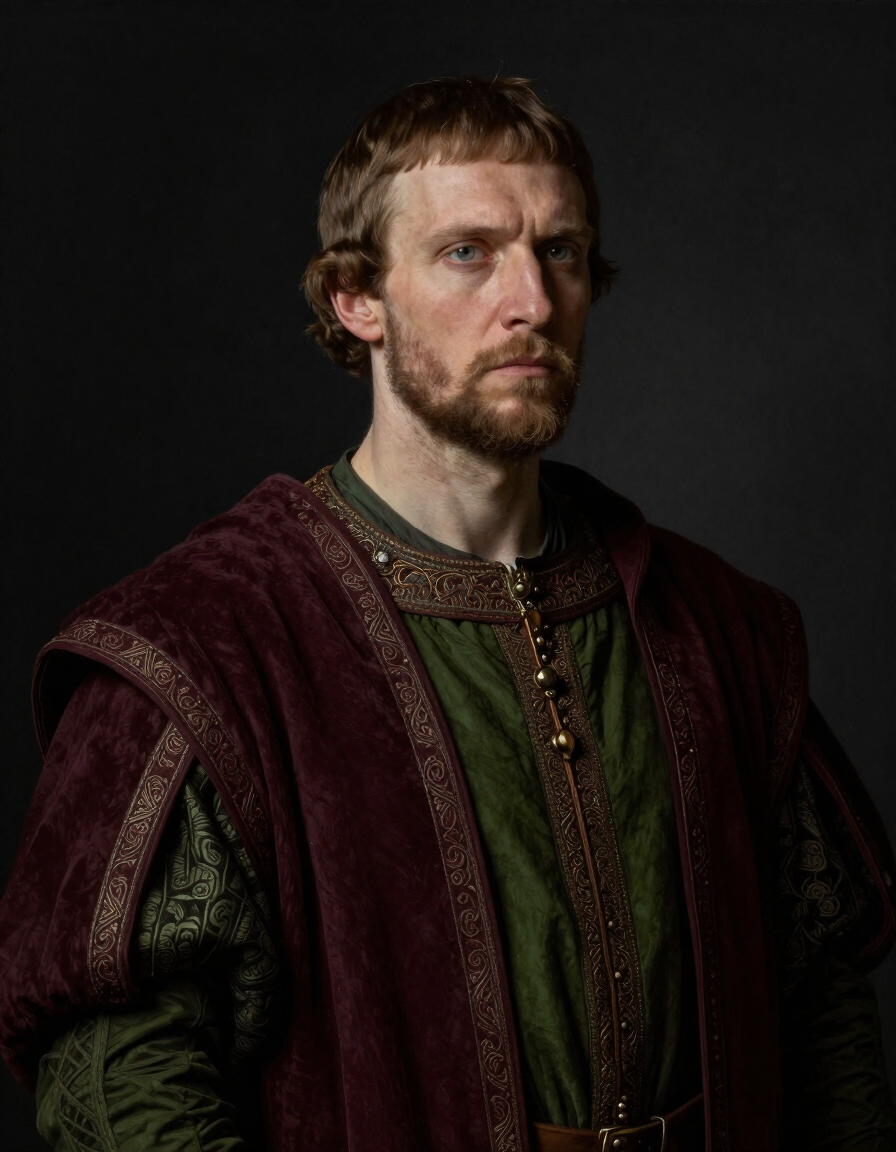
Dirk II
c. 917 – c. 988
Consolidated the county through diplomacy and land grants in the Ottonian era; the documentary record is thin but the charters survive.
Appears in: Books IV–V
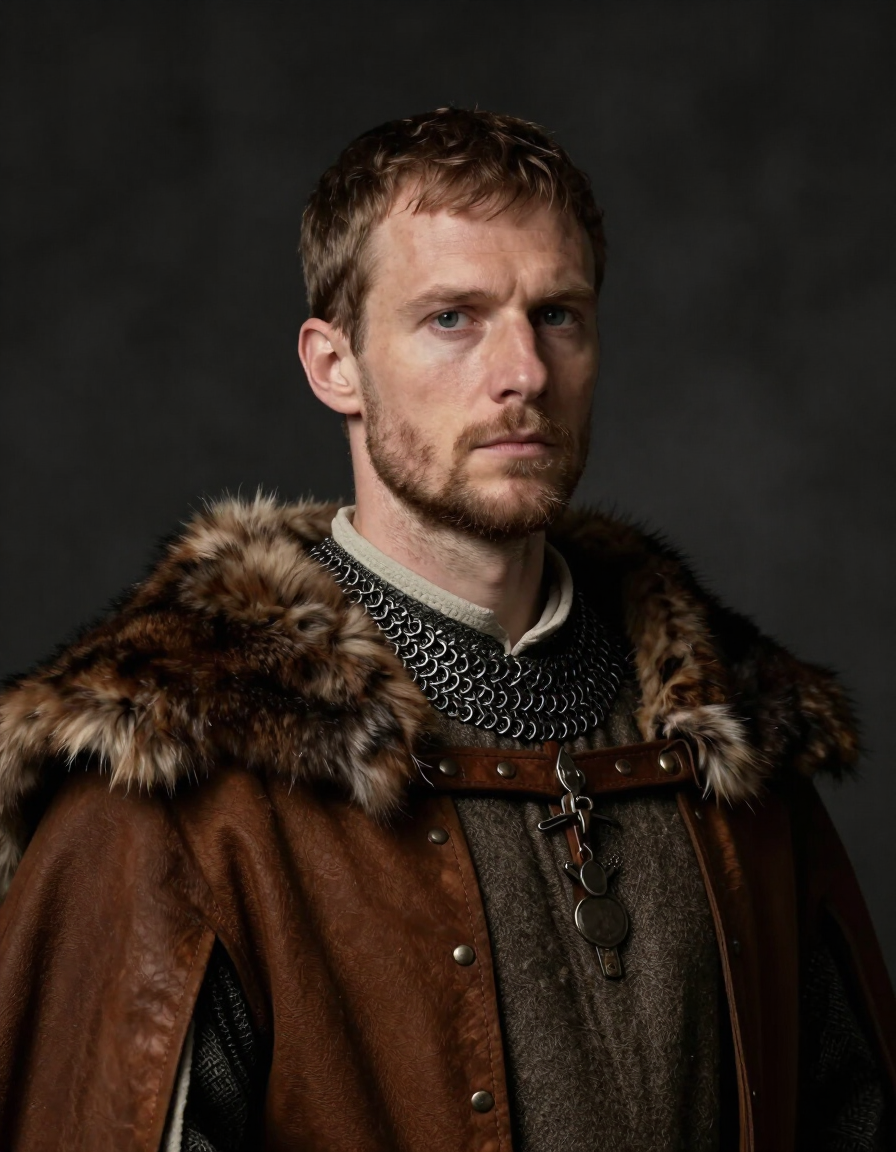
Arnulf
c. 951 – 993
Died at the siege of Tiel; the sources are sparse and contradictory, which is part of why he makes a compelling subject for fiction.
Appears in: Book VI
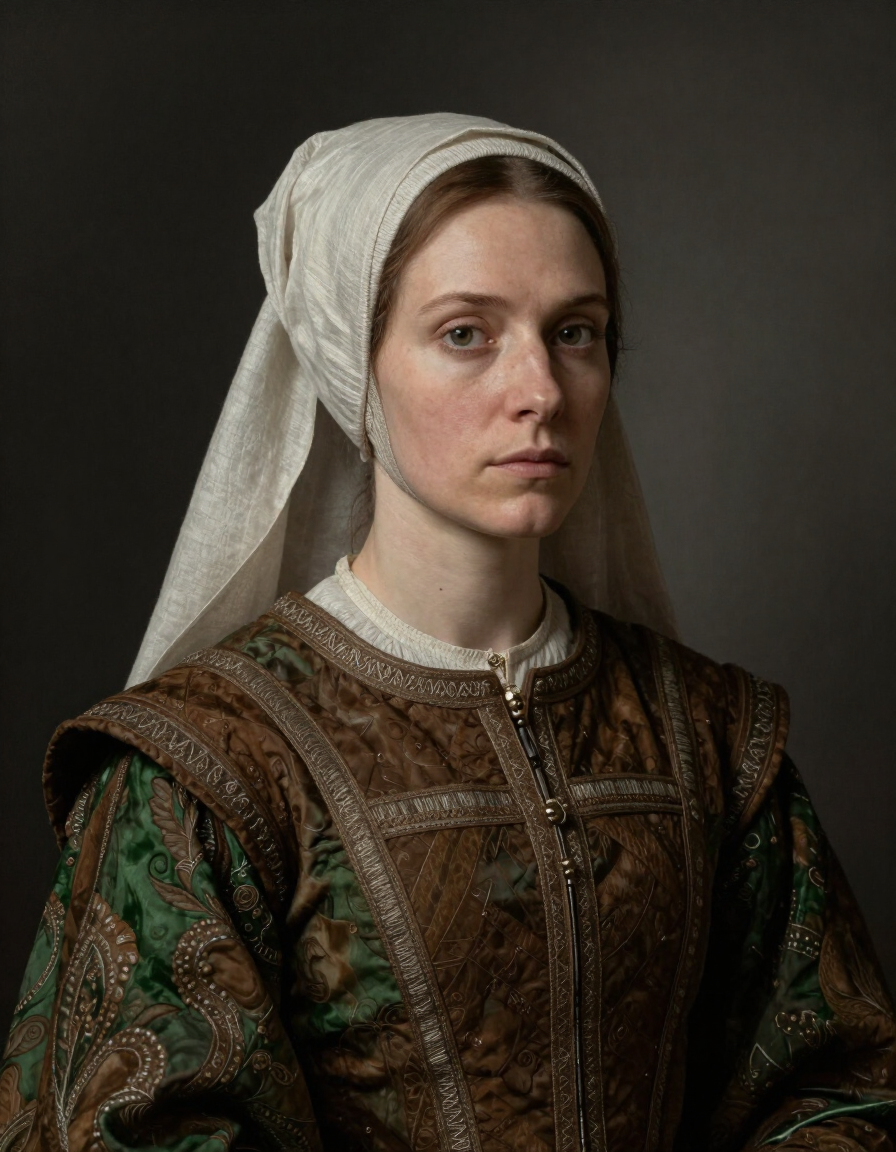
Liutgard
dates uncertain, active c. 960s–990s
Arnulf's mother and a significant political actor in her own right; the sources give her less space than her role seems to have warranted.
Appears in: Books V–VI
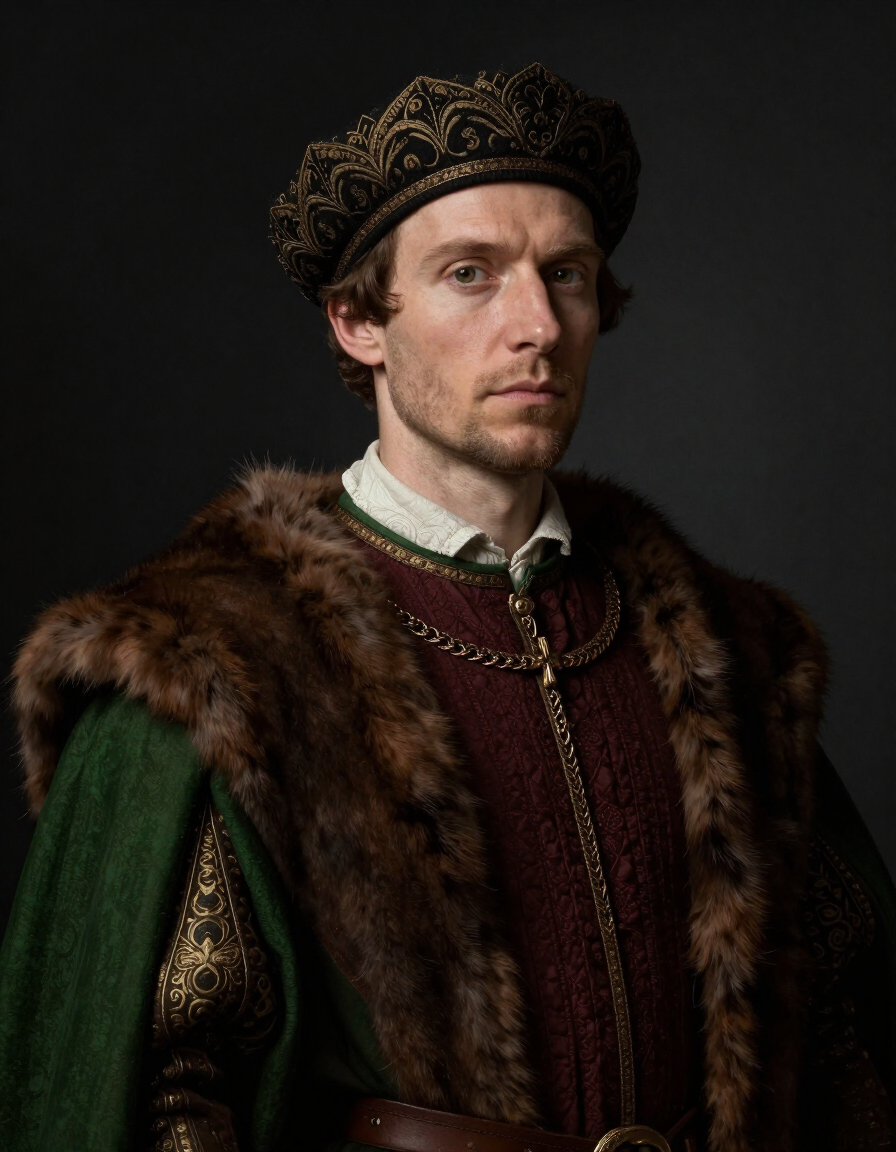
Floris V
1254 – 1296
"The God of the peasants" — the count who turned Holland into a coherent principality and was murdered for it; the planned final arc of the series.
Planned final arc
Follow the Research as the Series Grows
New articles published every fortnight — subscribe to follow the research as the series grows.
The newsletter carries new background articles, research notes, progress on the next volume, and occasional material that does not appear anywhere else. No frequency padding, no promotions — only substance. Double opt-in, genuine unsubscribe.