
Four centuries. One house. A country that did not yet exist.
Around the year 880 a man sits on the Frisian coast who calls himself count of a district of dunes, peat and water. Four hundred years later that district is called Holland, and his descendants are among the most powerful houses in the Low Countries. Between the one and the other lies The House of Holland.
It is not a story of battles alone. It is about land won from the water with a spade, about charters that promised something which did not exist in fact, and about people who had to choose between what was right and what was sensible — and who did not always see the difference in time.
Eight volumes have appeared, from Gerulf to Dirk III. The series runs on to Floris V.
Episode I — Dirk I (c. 880–923)
Episode II — Dirk II (c. 940–988)
Between the dunes and the peat of ninth-century Frisia lies a mound called Egmond: a timber hall, a few hamlets of fishermen and farmers, a lord the chronicles barely trouble to name. From that forgotten place came the line that would one day hold the whole coast in its hand. Three novels, forty years, one house — written for adult readers, where the violence is not softened and nobody is wholly clean.
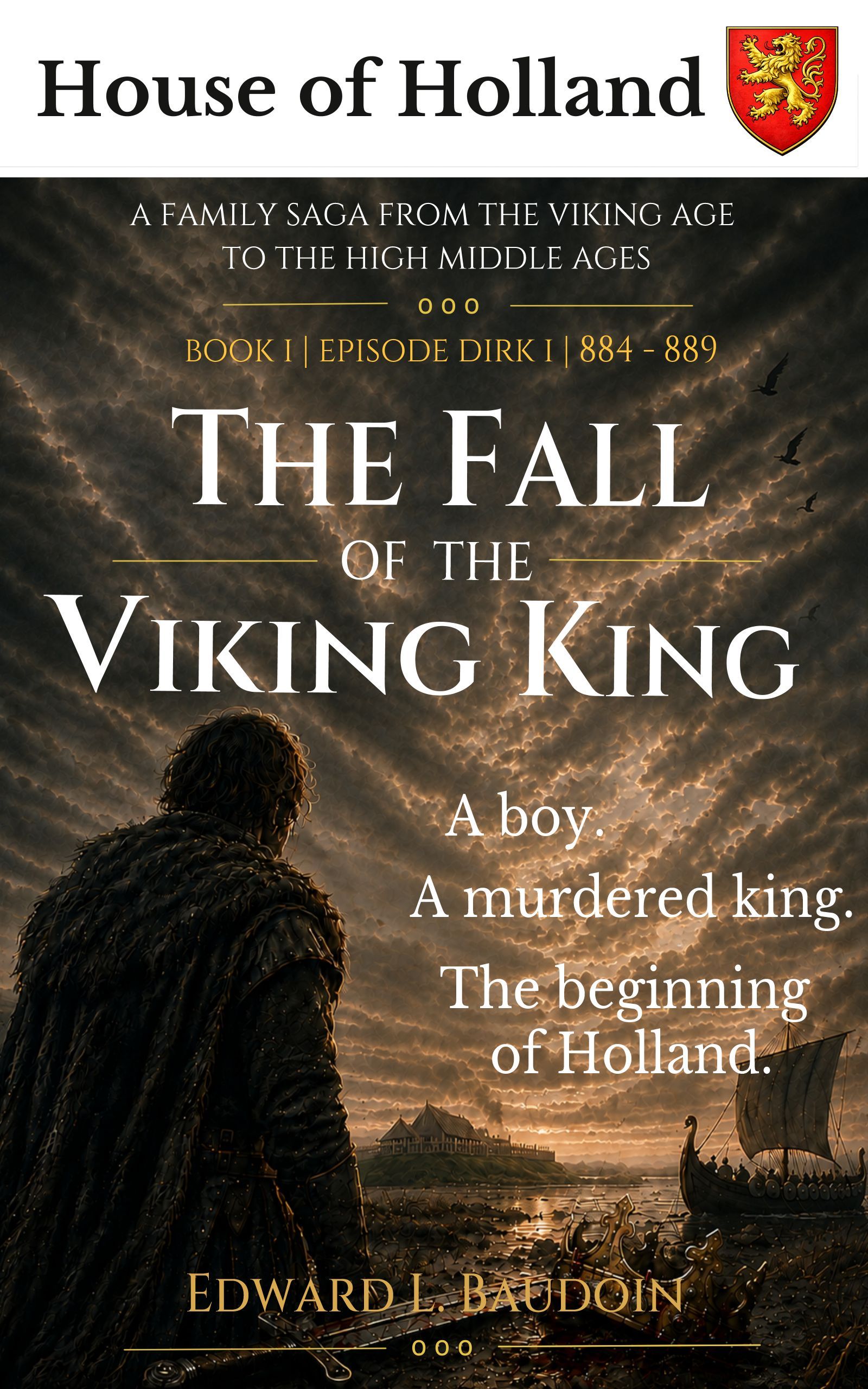
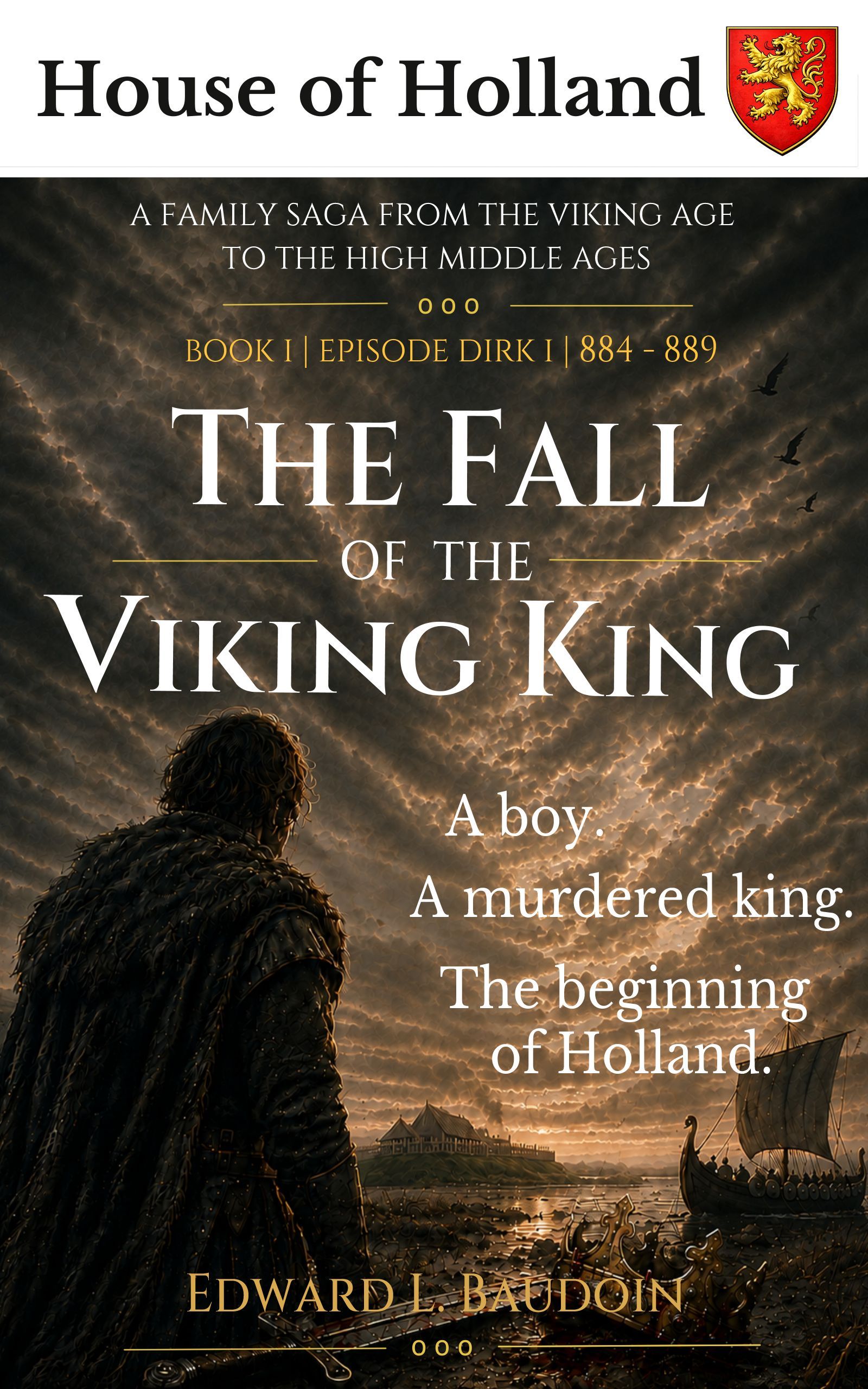
The Fall of the Viking King (884–889) opens on a coast that has listened to the night for oar-strokes for a hundred years, under the sign of the black raven. Gerulf of Egmond is not large and not loud; he holds his coast by guile where other men lose theirs by courage. Sent south with a Danish king's demand to the emperor, he learns where the man who sent him is weak. What follows is a conspiracy, a meeting called under safe conduct, and blood in the grass. The deed wins him a charter sealed by a king. It also puts something into the water.
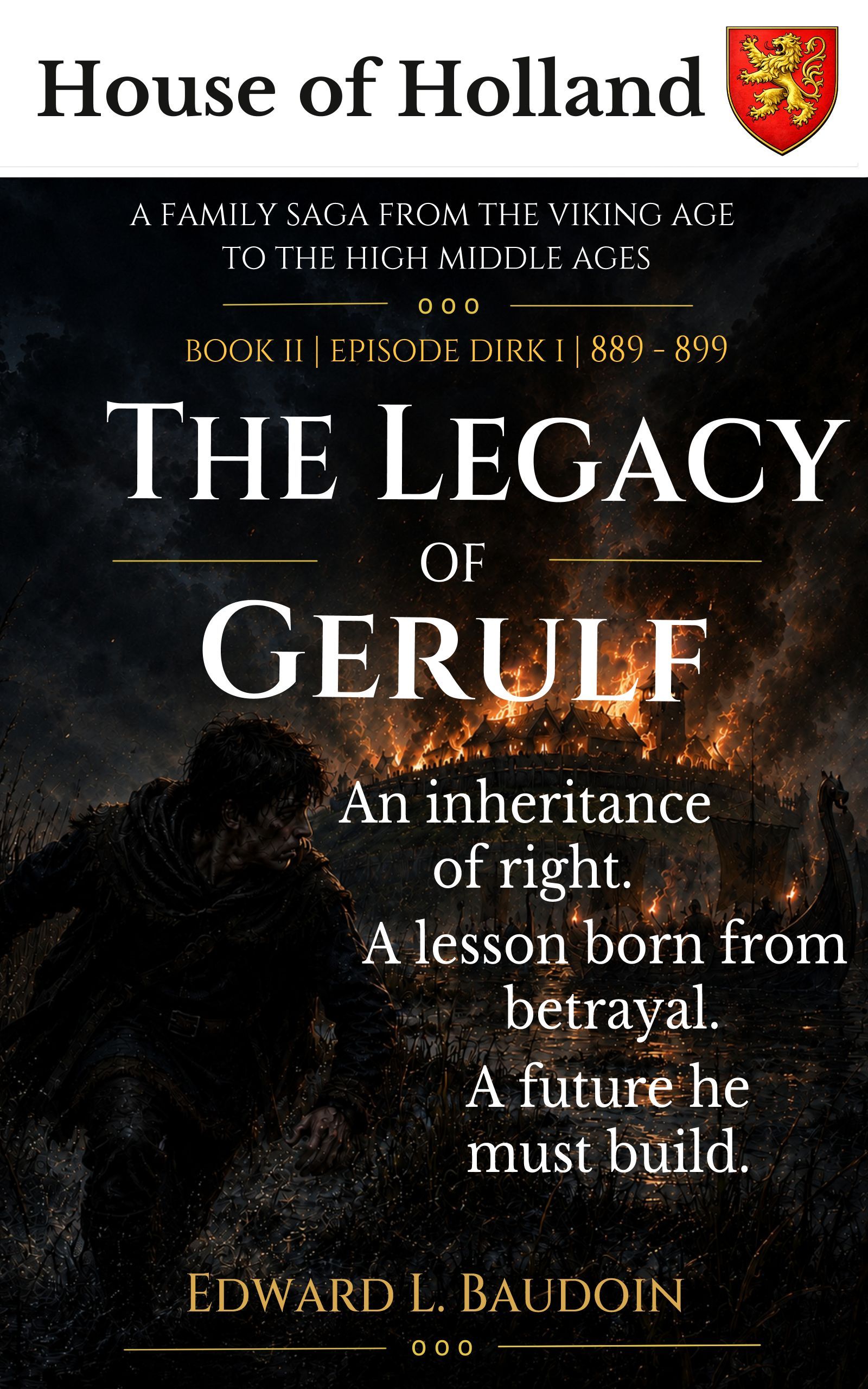
In The Legacy of Gerulf (889–899) the ravens stay away for a single winter, and a people who have never lived without fear do not know how to trust it. Two sons must divide what one father built. Beside the charter that all the world may see lies a second inheritance, to which no wax bears witness: that a house does not fall to the enemy at the gate, but to the dagger at its own table. That war cannot be won, because to win is to lose someone you love.
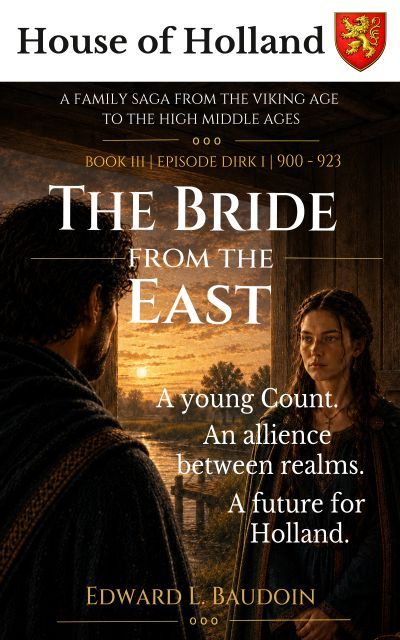
The Bride from the East (c. 900–923) finds Dirk count alone, with a right, a lesson, no son to hand them to, a brother he no longer speaks to and a blood feud in the east. The remedy is a marriage into the house whose blood Egmond has spilt — but Gerberga of Hamaland has her own grief and her own will, and every right to refuse him. Around them stand a wedding day an avenger has already marked, and a battle at Soissons that will demand of Dirk the one loyalty he has never traded away.

North of Egmond the land stops being land: reed, black water, peat that breathes beneath your feet, and free Frisians who build no strongholds and bow to no lord. An army you can defeat; this land you cannot. There are inheritances that make a man rich, and inheritances that only set him in the middle of a target with his name above his head. Dirk II's was of the second kind.
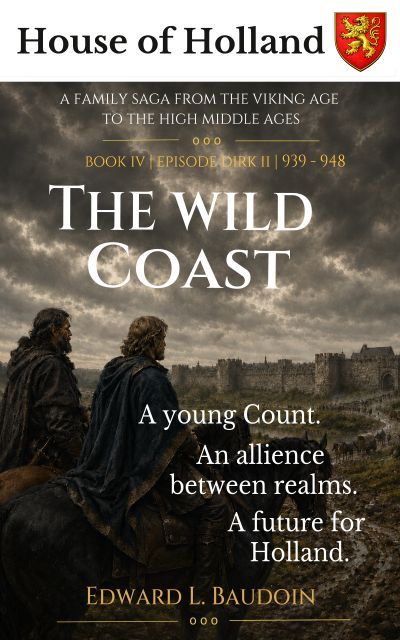
The Wild Coast (939–948) opens with beacons burning in the north and a young count holding a charter that fewer and fewer hands will honour. The bishop of Utrecht is writing parchment of his own, one that makes the coast the Church's; the Frisians take what they please; and in the south lies Flanders, rich and smiling and merciless. Dirk buys his standing with a marriage — Hildegard of Flanders, who reckons everything — and pays for it under a king's ban, at the walls of Reims, in mud. He rises. The book is about what he gives away to do it.
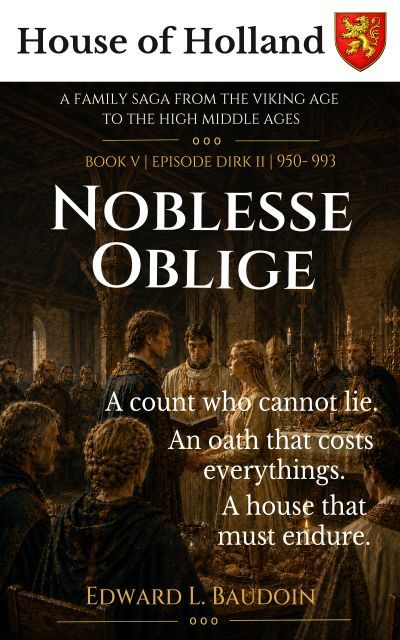
Noblesse Oblige (950–977) begins with a woman studying a wooden floor. On this coast everything is of wood, and wood is made to disappear; a house that owns nothing worth taking cannot be robbed. But a saint who lies in wood is, within a century, a saint nobody can find. So they break open the chapel floor, lift the old count out and lay him in stone — and stone says: I intend to remain, I have something worth defending. What is worth defending is worth taking. Utrecht, Ghent and the emperor all come to read that claim, a second son is given away to the Church, and Dirk learns the difference between the two prices a house can pay.
Rising costs you everything you love, once. Staying costs a little blood every year, forever.
Episode III — Arnulf (977–993)
In the spring of 965 a boy of fourteen stands at the back of an abbey church in Ghent, at the burial of the greatest man in the West. He is the only one of his house present, and nobody appointed him. A cousin of the dead count tells him kindly that a name is not a right, and that he should go home. The boy does not know where that is.
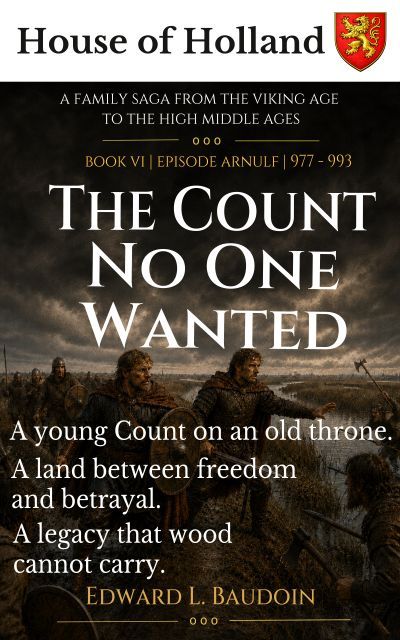
The Count Nobody Wanted (951–993) is the story of an heir raised in the wrong country. Arnulf is Flemish in his speech, his clothes and his friendships, and the inheritance waiting for him is a poor, wet coast a hundred miles to the north that has never laid eyes on him. He gets everything and is consulted about nothing. When at last he comes to take what is his, he arrives among people who know his name and care nothing for it.
House of Holland
Coming
In Progress
Episode IV — Dirk III (c. 993–1039)
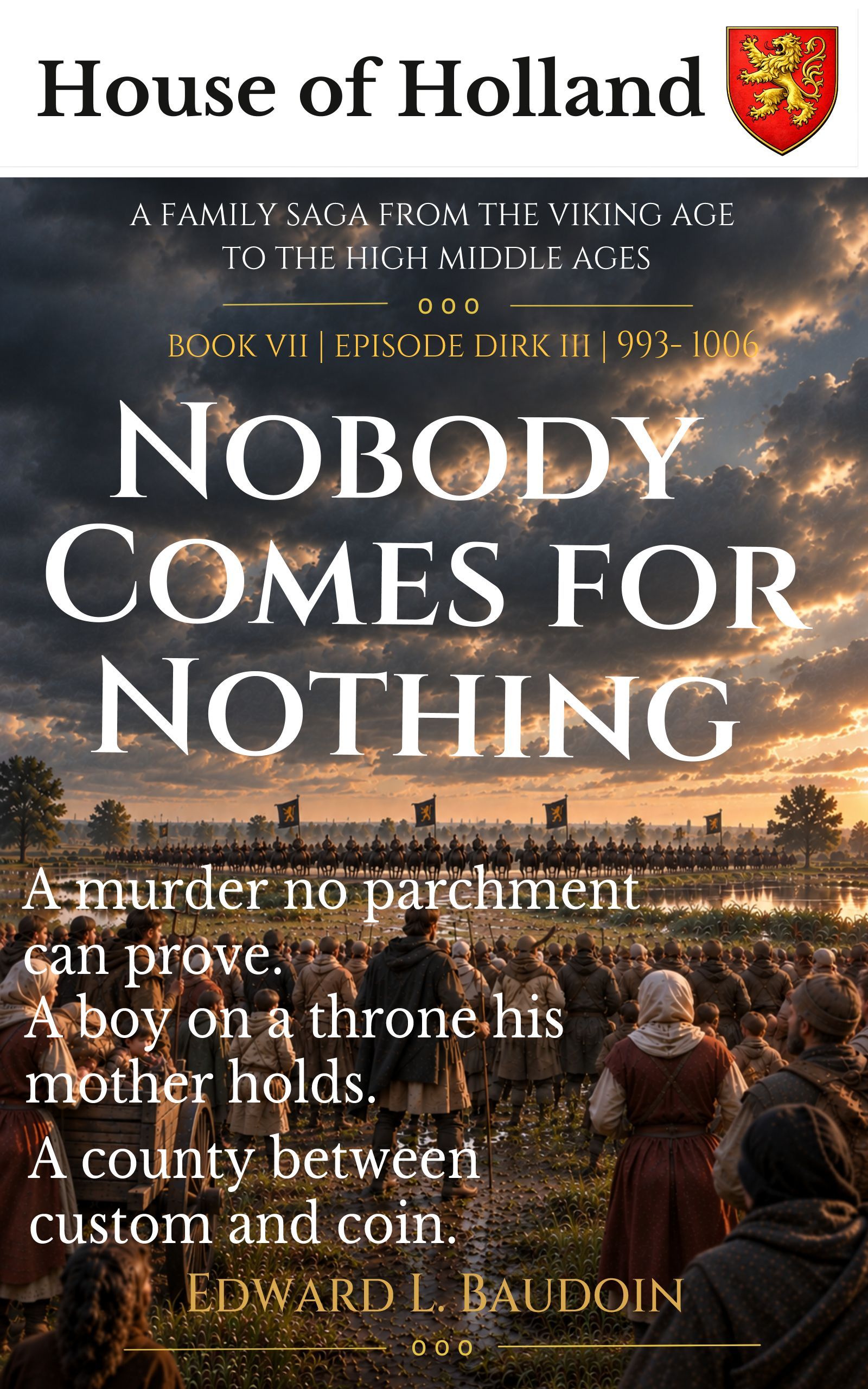
In the autumn of 993 an eleven-year-old boy becomes count of a country he cannot yet rule. His father is dead, his mother is a hundred and fifty miles away, and another man is already sitting in the hall at Egmond. Dirk has the title. Other men have the soldiers, the money and the experience. His mother, Liutgard of Luxembourg, has only her sons, fifty borrowed men, and the knowledge that nobody comes to help for nothing.
Nobody Comes for Nothing (993–1006) is the first of three books telling the story of Dirk III, the count who would rule Frisia for forty-six years. It begins with a widow fighting to preserve an inheritance for a child and a boy learning what it costs to keep what is supposedly already his. Around them, reeves, bishops, Flemings and emperors all have their own interests — and every offer of protection carries a price.
Dirk will grow up in a county where almost nothing is written down, loyalty lasts only as long as men remember it, and power belongs less to the man with the best claim than to the one who is still standing when everyone else has finished making theirs.
This is where the story of Dirk III begins.
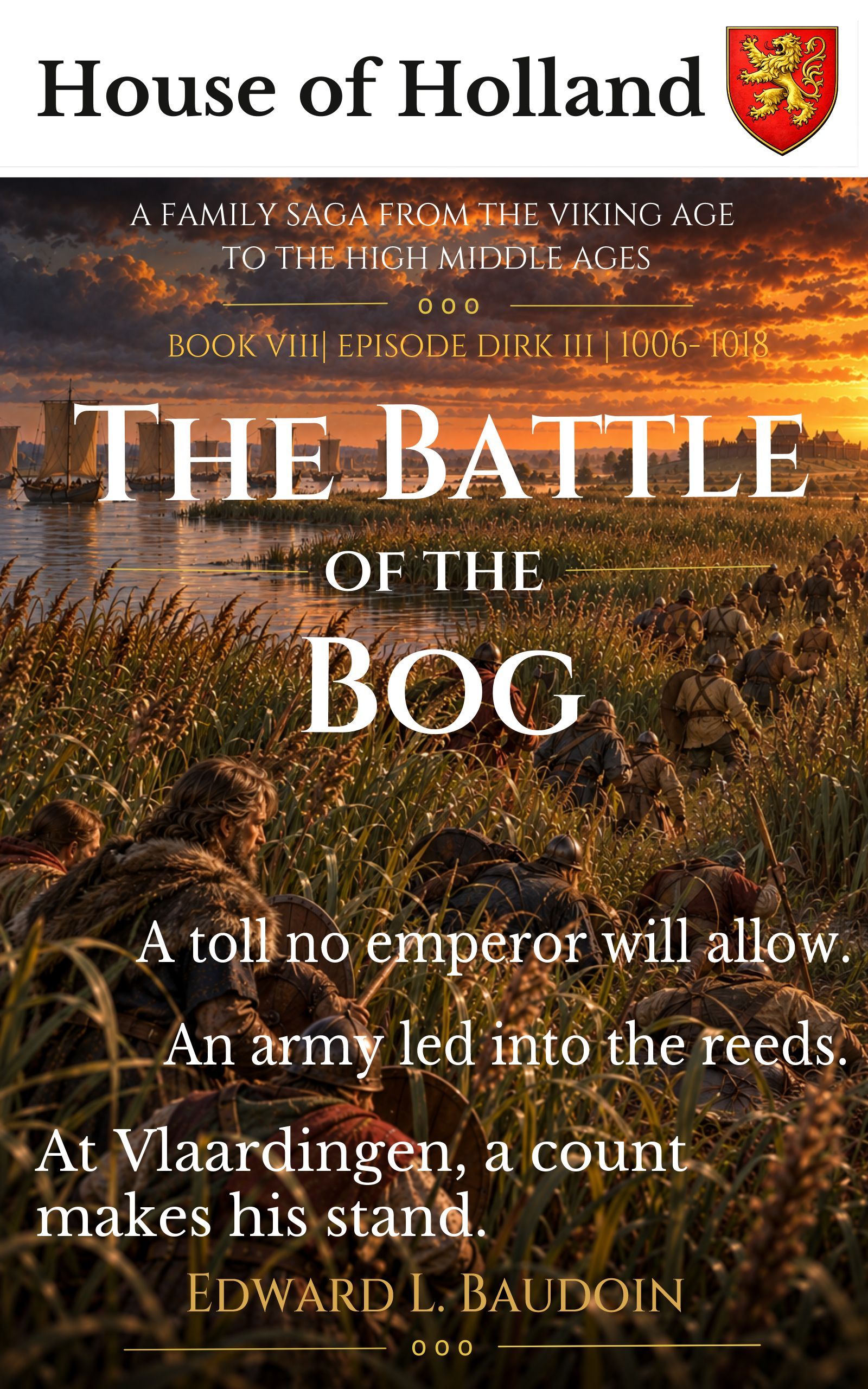
In the autumn of 1006 Dirk III is twenty-four years old and finally rules in his own name. What he has inherited is hardly a kingdom: a hall at Vlaardingen, a house at Egmond, sixty paid men and a stretch of wet country at the mouth of the great rivers. But every merchant sailing between the Rhineland and the North Sea must pass his shore — and Dirk has discovered that control of the water may be worth more than ownership of the land.
The Battle of the Bog (1006–1018) is the second of three books telling the story of Dirk III, the count who would rule Frisia for forty-six years. It follows a young ruler turning an uncertain inheritance into something much harder to take from him. Merchants from Tiel challenge his tolls, bishops invoke rights written on parchment, and kings and emperors begin to notice what is happening in the marshes at the edge of their realm.
For twelve years the pressure builds. Dirk strengthens Vlaardingen, learns to use water, mud and distance as weapons, and refuses to surrender what others insist was never his. Eventually argument gives way to force. In 1018 an imperial army comes west to settle the matter — and discovers that fighting in Frisia means fighting the land itself.
This is the story of how a dispute over a river became the Battle of Vlaardingen — and how a count on the edge of the empire made the empire come to him.
Future Episodes — Planned
House of Holland
Coming
House of Holland
Coming
House of Holland
Coming
Planned
The series continues through Dirk III, Floris I, Floris II, and onward to Floris V, † 1296. New volumes publish as they are completed.
Buy the Series
All six published volumes are available in Kindle and paperback. English editions are sold through Amazon .com and .co.uk; Dutch editions through bol.com, Amazon .nl, and Amazon .de. Select the storefront for your region.
Dutch Editions / Nederlandse uitgaven
Links may include an Amazon Associates affiliate tag. As the author, Edward L. Baudoin earns a small commission on qualifying purchases at no extra cost to you.